Pre Rup on the Angkor Grand Circuit
Pre Rup on the Angkor Grand Circuit lines up a 10th century brick pyramid, five towers, and a 360 degree view in a short climb most travelers finish in ten minutes.
Stand twelve meters above the trees on a brick pyramid from 961 and watch the sun drop toward Angkor Wat while the tour vans head back to town. No queue. No rush. Photos you will print and frame.
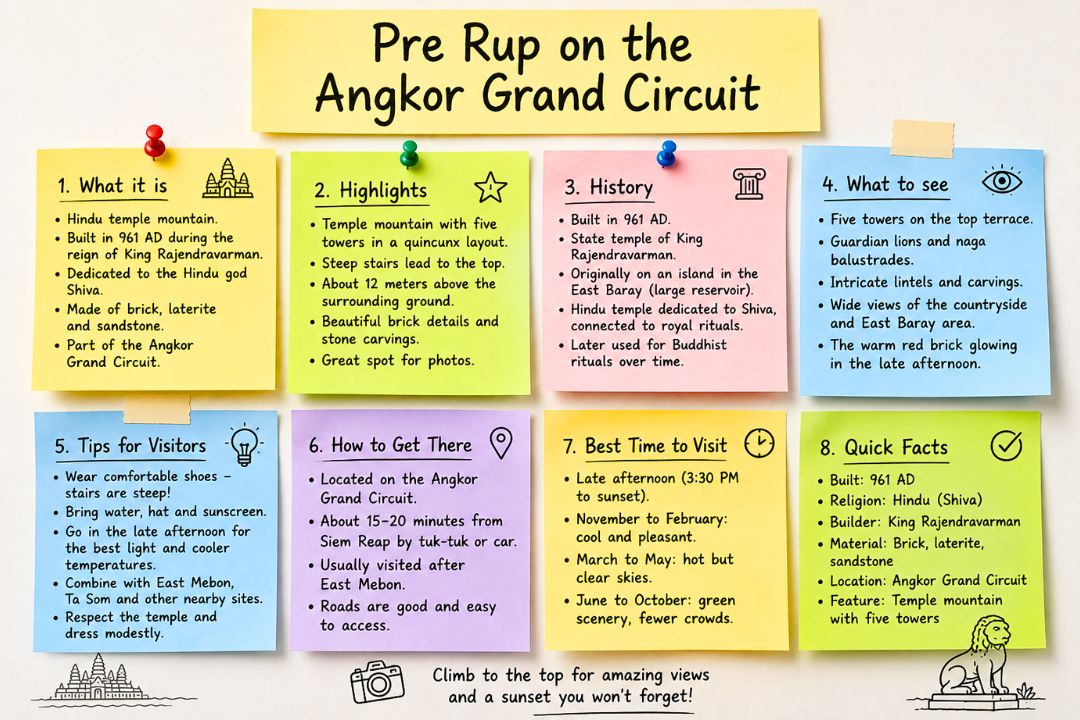
Pre Rup on the Angkor Grand Circuit is where I send guests who want wide views without the Bakheng crowd. This 10th century brick pyramid in Siem Reap, Cambodia, was built as the state temple of King Rajendravarman and dedicated in 961.
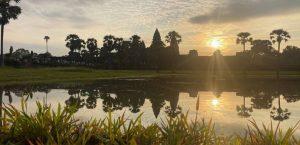
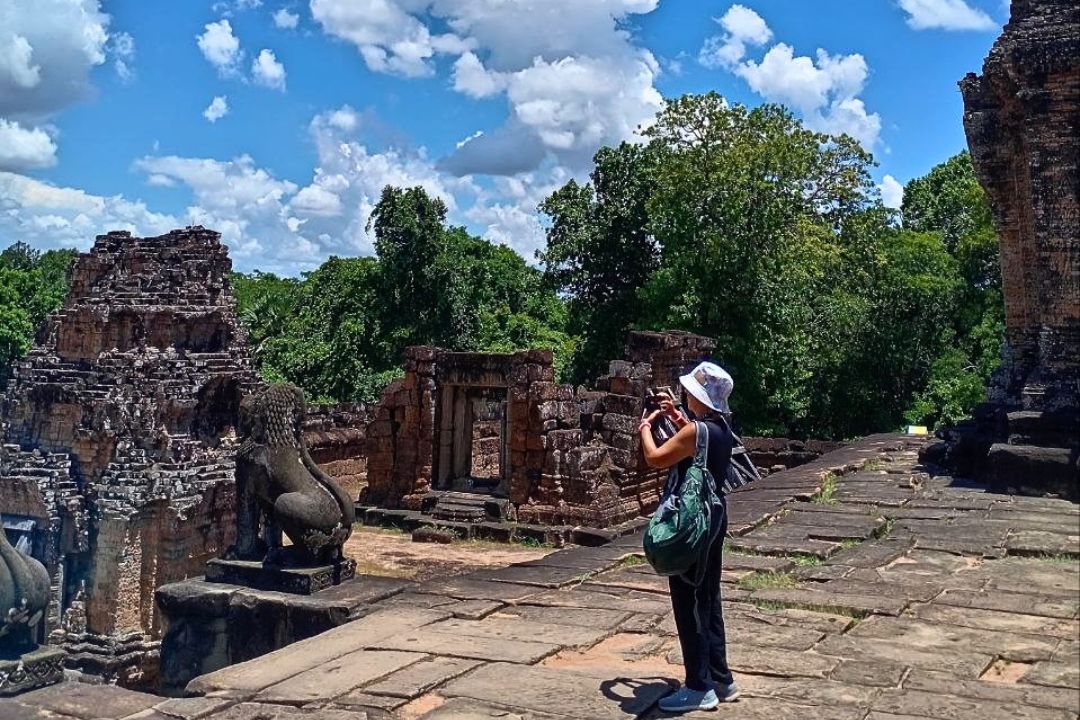
The climb is short, the stairs are wide, and the payoff is a 360 degree panorama over rice fields, Phnom Bok, and the towers of Angkor Wat on fine days. Go late in the afternoon and the warm brick turns red in the low sun.
A one day Angkor pass covers the whole park, so Pre Rup on the Angkor Grand Circuit adds zero extra cost to your trip. Give it 45 minutes and you leave with your favorite photo set of the week. Stair tips, light timing, and the honest sunrise versus sunset verdict come next.
Key Benefits
Pre Rup on the Angkor Grand Circuit hands you a climbable temple mountain, five brick towers in a quincunx, and a full circle of sunset views in about 45 minutes.
- A brick temple mountain raised for a king in 961, still upright after one thousand years
- Five towers on top, one at each corner and one in the middle
- A 360 degree panorama over rice fields, Phnom Bok, and the Angkor Wat towers
- A short climb of about 12 meters, with handrails on the main stair
- One Angkor pass covers it, and it pairs with East Mebon and Banteay Srei on a single day out
Key Takeaways
- Go in the late afternoon and the brick glows warm red as the sun drops
- The climb is short: about 12 meters up in under ten minutes
- One pass covers everything: 37 US dollars for a day, 62 for three days, 72 for seven
- A guided full day trip with cold water and an air conditioned van starts at Pre Rup for 20 dollars
The Honest Opening
I have lived in Siem Reap for years, and I still climb Pre Rup for my own sunset. Almost every guest I take there sends me the same message later: why did no one tell me sooner? Fair question.
Pre Rup sits on the east side of the park, far from the sunrise rush at Angkor Wat. The sunset crowd piles onto Phnom Bakheng, and most visitors ride right past this red brick pyramid. Their loss is your gain, honestly.
Why Does Pre Rup on the Angkor Grand Circuit Beat the Crowded Sunset Temple?
The Short Answer
Same wide views, a fraction of the wait. Pre Rup has no entry cap and no line, so you can arrive late and still grab a good spot.
Phnom Bakheng earns its fame, no argument. It also pulls the biggest sunset crowd in the park: gates, waits, and a summit packed shoulder to shoulder. I take guests to Bakheng when they insist, and I take them to Pre Rup when they want their evening back.
Park, walk through the east gate, and climb straight up. Thirty minutes before sunset is plenty. Ask anyone who has waited on Bakheng stairway while the light died.
One more point: brick and laterite steps, worn down over centuries, with handrails on the steep middle.
When Should You Visit Pre Rup on the Angkor Grand Circuit?
The Short Answer
Late afternoon wins for most people. Be at the top by 4:30 pm and stay through sunset for the warm brick glow.
Mornings give you cool air and soft pink light, but the sun rises behind the temple, so you face the glare. Afternoons paint the brick a warm orange-red that photographs like a filter you did not earn.
By 5 pm, the big tour vans head back to town, and Pre Rup goes calm. You can hear birds and wind between the towers. That quiet is the real treat here.
The summit has no shade, so bring water and a hat.
| Factor | Sunrise | Sunset |
|---|---|---|
| Light | Soft pink on the brick | Warm red glow on the towers |
| Crowds | A few photographers | Busy but far lighter than Bakheng |
| Pickup from town | About 5:00 am | About 3:30 pm |
What Will You See From the Top?
The Short Answer
A full 360 degree horizon of rice fields, forest, Phnom Bok, the Phnom Kulen hills, and on fine days the towers of Angkor Wat to the west.
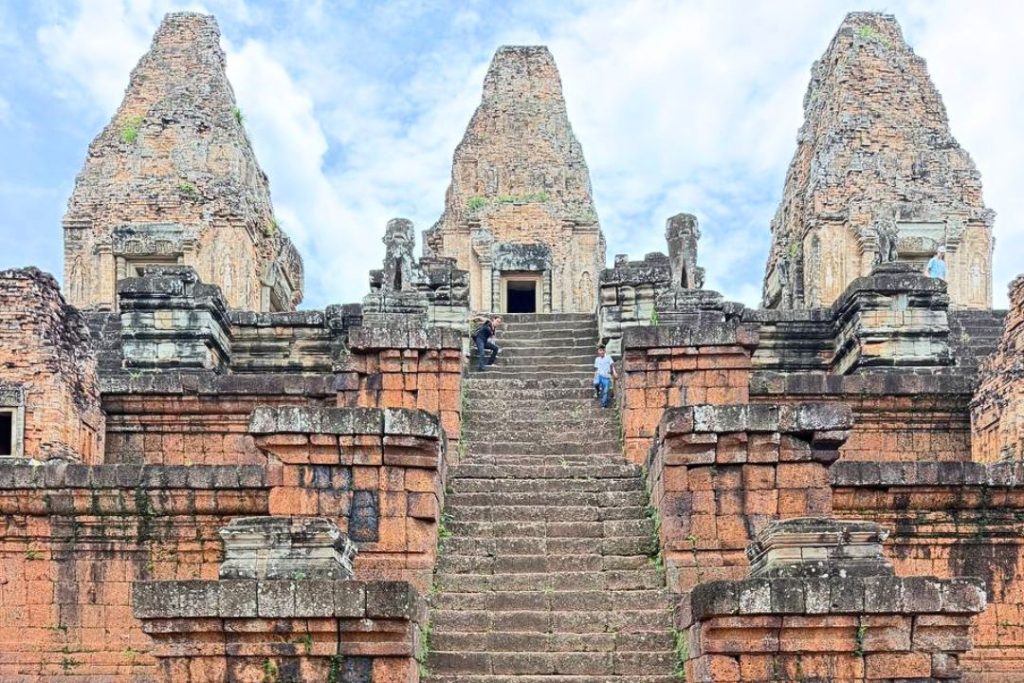
The summit holds five towers in a quincunx: one at each corner and one in the middle. A quincunx is a layout with four points at the corners and a fifth at the center. That center tower is your favorite prop, and the whole peak clears the tree line.
Photo Spots Worth Your Time
- West edge before sunset: the Angkor Wat towers line up on the horizon
- Central tower base: frame it against the corner towers for the classic five tower shot
- East stairs in the morning: long shadows cut across the laterite
- The top platform: step back for a wide shot over the rice fields
How Hard Is the Climb?
The Short Answer
Easy for most travelers. The final pyramid rises about 12 meters in three steep tiers, and a relaxed pace gets you to the summit in under ten minutes.
The steps are steep and worn in the middle, so use the sides. Flip-flops get you up, but grippy soles make the way down feel safe. I push guests toward shoes with real tread, and nobody has complained yet.
Five minutes if you move, ten if you stop for photos.
What Is the Story Behind Pre Rup?
The Short Answer
King Rajendravarman raised Pre Rup as his state temple, and it was dedicated in 961 or early 962. The name means “turn the body,” tied to a cremation rite where ashes were rotated as the ceremony went on.
The masons used brick, laterite, and sandstone, which makes it one of the largest brick monuments in Khmer history. It is a temple mountain, the Khmer way of stacking a stone Mount Meru, the center of the universe in Hindu belief. An outer laterite wall runs 117 by 127 meters around the site.
By the early 1900s, the temple sat buried in vegetation and dirt. French conservators George Trouve and Henri Marchal dug it out in the 1930s. What you climb now is their work, restored and stable.
The funerary name spooks some visitors. It should not. Your visit is a photo walk, not a ceremony.
How Much Does It Cost to See Pre Rup on the Angkor Grand Circuit?
The Short Answer
The same Angkor pass that covers Angkor Wat also covers Pre Rup on the Angkor Grand Circuit. In 2026, one day costs 37 US dollars, three days cost 62, and seven days cost 72.
You can buy the pass on the official government site before you fly. A one day pass suits a tight schedule. The three day pass is what I pick for most guests, because it leaves room for sunrise plans and a slow second loop. Prices checked in August 2026.
Staff check passes at temple gates, so keep yours on you. Photocopies do not work. A photo of the barcode usually does, but the paper card is safest.
| Pass | Price | Who It Suits |
|---|---|---|
| One day | 37 US dollars | A single big loop with Pre Rup on the Angkor Grand Circuit |
| Three days | 62 US dollars | Sunset at Pre Rup plus two relaxed mornings |
| Seven days | 72 US dollars | Slow travel and repeat photo sessions |
Where Does Pre Rup Sit on the 26 Kilometer Loop?
The Short Answer
The Angkor Grand Circuit runs about 26 kilometers around the outer temples, and Pre Rup on the Angkor Grand Circuit marks its southern end, reached right after East Mebon.
The common order runs from Angkor Wat to Preah Khan, then Neak Pean, Ta Som, East Mebon, and Pre Rup. A van with a driver is the normal way around, since walking that distance is not realistic.
One tip I give every guest: run it backward, starting at Pre Rup in the morning when the brick glows pink and ending at Preah Khan in the late afternoon. Most vans run the loop the same way, so you stay ahead. For the full stop by stop plan, read our Angkor Grand Circuit tour with a local guide.
Pre Rup pairs well with East Mebon, its near neighbor of the same style and age. Add Banteay Srei and you get three kinds of Khmer temple in one day.
How Do You See Pre Rup Without Planning Anything Yourself?
The Short Answer
Book the Banteay Srei Backcountry tour, an eight hour small group trip that starts at Pre Rup and covers six temples for 20 dollars.
The tour picks you up at your hotel between 7:40 and 8:10 am, leaves town at 8:30, and drops you back around 4 pm. You get an air conditioned minivan, an English speaking guide, cold water, and cold towels. Group size caps at ten people, the minimum age is 12, and the temple pass and lunch are not included.
The route runs Pre Rup first while the stone is cool, then Banteay Srei, lunch, East Mebon, Ta Som, Neak Pean, and Preah Khan.
Why does this combo work? Pre Rup fills the temple mountain slot, Banteay Srei fills the carving slot, and Preah Khan closes the day with long corridors and quiet corners.
Dress for it: cover your shoulders and wear trousers or knee length shorts. The gate staff enforce the rules.
What Should You Do Next?
- Buy your Angkor pass online ahead of time, on the official site
- Pick the three day pass unless your trip is tight
- Book the backcountry tour or a private van
- Pack water, a hat, and shoes with grip
- Get to the summit by 4:30 pm and stay for the glow
- Send us your travel dates via our contact page and we will plan the rest around you
Years of running tours in Siem Reap have taught me that the famous names sell tickets and the quiet ones sell memories. Pre Rup on the Angkor Grand Circuit is a quiet one. Climb it once and you will see what I mean.