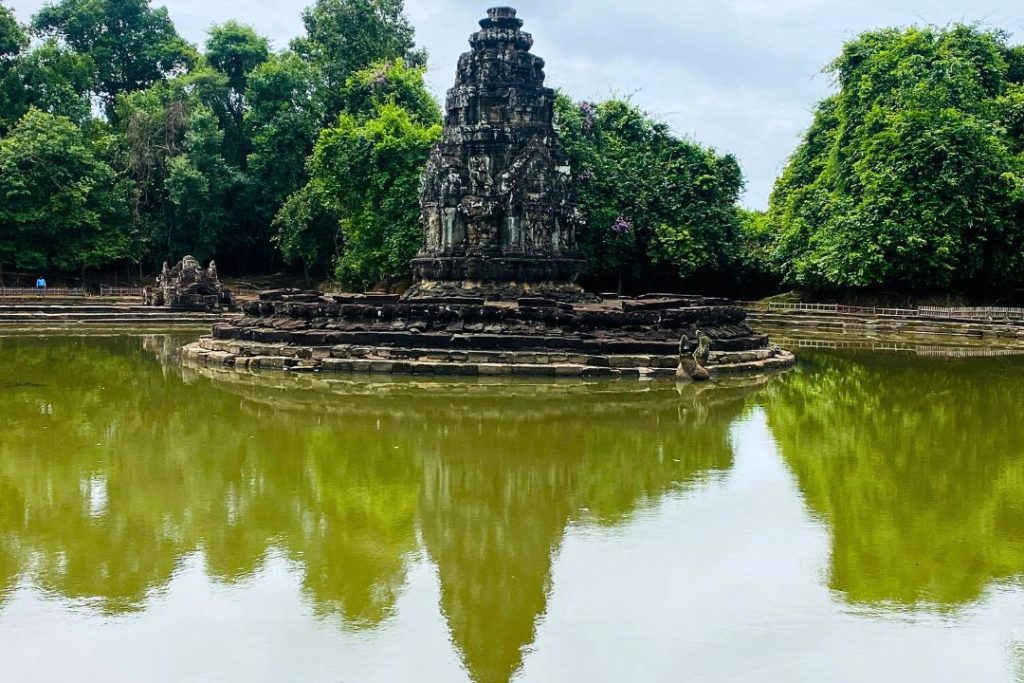
Neak Pean on the Angkor Grand Circuit
Neak Pean on the Angkor Grand Circuit gives me one of the calmest temple stops in Angkor, with sacred pools, a short walk, and a smart place to slow down between bigger sites.
Turn a short temple stop into your calmest Angkor hour, with less crowd strain, better pacing, and a richer temple day.
Neak Pean on the Angkor Grand Circuit is one of the shortest temple stops in Angkor, but I rate it as one of the most rewarding when I plan a full day out. It stands on a small island ringed by old pools, so the setting feels different from the tall stone towers many people rush toward first. I like it because it gives your day a quiet middle point, not just another temple tick on a list. UNESCO links Neak Poan to an ancient hospital, which gives the stop a healing story that fits the water layout around it.
The official Angkor pass still makes this stop easy to add, with the same temple park ticket covering more than 50 sites. If you want Neak Pean on the Angkor Grand Circuit to feel worth the drive, I would pair it with Ta Som, Preah Khan, and a slower route that leaves room to walk, pause, and take it in.
Neak Pean on the Angkor Grand Circuit, at a glance
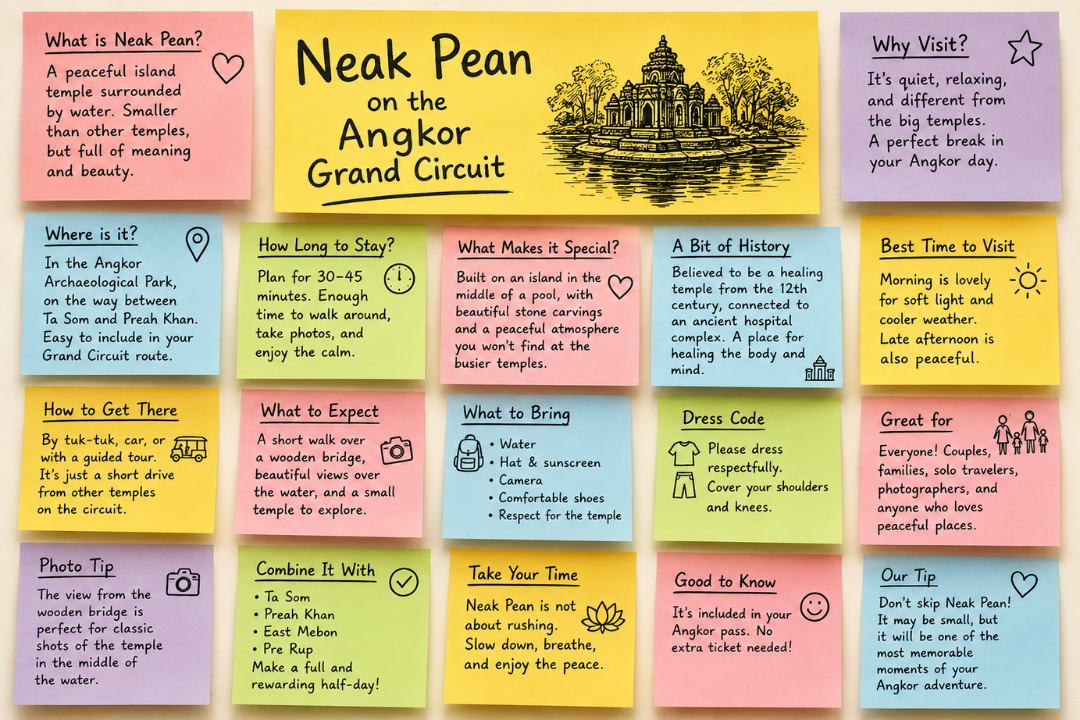
Neak Pean on the Angkor Grand Circuit works best for travelers who want a calmer stop between larger temple visits. I like it for the island setting, the sacred water story, and the way it breaks up a long temple day without wasting time. It also fits well into a one-day route with Ta Som, Preah Khan, East Mebon, and Pre Rup.
Key takeaways
- I treat Neak Pean as a short but high-payoff stop
- The temple sits on an island surrounded by old pools
- UNESCO notes Neak Poan as an ancient hospital
- The stop makes more sense when you pair it with nearby temples
- I would give it about 30 to 45 minutes on most routes
- A one-day Angkor pass still covers 50 plus temple sites
- Official 2026 ticket prices remain 37 USD for 1 day, 62 USD for 3 days, and 72 USD for 7 days
- Dress rules still matter, so shoulders and knees should stay covered
- If you want a ready-made route, my Banteay Srei Backcountry Tour already includes Neak Poun with other strong stops
I plan temple days around pace, not only around fame. That is why I keep Neak Pean high on my list when someone wants a day that feels full without feeling heavy.
A lot of Angkor visits go wrong in the same way. People stack giant temples back to back, walk too far in hard heat, then reach the late afternoon flat and tired. Neak Pean fixes that. The stop is lighter on the legs and richer in mood.
It also gives shape to the day. After dense stone galleries and big temple grounds, the island layout and water setting feel fresh. You keep your energy. You keep your focus. You also leave with a stronger sense of how varied Angkor really is.
- You get a calmer stop in the middle of a busy route
- You see a temple tied to water, ritual, and healing
- You cut temple fatigue on a long circuit day
- You stay close to other strong Grand Circuit stops
- You keep room in the day for photos, rest, and a slower lunch
- You can fit it into a group tour or a private route with ease
What makes Neak Pean on the Angkor Grand Circuit worth your time?
It gives me a rare quiet stop with a story that stays with people.
I do not send people to Neak Pean for size. I send them there for feel. The site stands apart because the water is part of the temple idea, not just the backdrop. That matters when you have already seen a run of sandstone towers and long causeways.
UNESCO says the Angkor complex covers about 400 square kilometres and includes temples, reservoirs, canals, dykes, and roads. That matters here because Neak Pean makes the water side of Angkor easier to feel in person, not just to read about later. When I bring people here, they start to grasp that Angkor was not only a set of temples. It was also a planned sacred zone shaped by water.
UNESCO also notes that Preah Khan was seen as a university of medicine and Neak Poan as an ancient hospital. That one detail changes the visit. The pools stop looking like decoration. They start to feel tied to ritual, healing, and belief.
What will I actually see at Neak Pean?
You will see a compact island temple framed by water, with a layout that feels distinct from the bigger Angkor stops.
The temple does not take long to walk. That is part of its appeal. I can fit it into a packed day without turning the stop into a rush.
The scene is what people remember. Water surrounds the central area. The approach feels open. The mood is softer than what you get at larger temple sites with heavy stone corridors. On a hot day, that shift matters more than many people expect.
Here is how I compare the stop with two nearby favorites when I plan a Grand Circuit day:
| Temple stop | What I go there for | Time I usually set |
|---|---|---|
| Neak Pean | Sacred pools, quiet island setting, short reset in the day | 30 to 45 minutes |
| Ta Som | Compact ruins, tree-framed gate, fast stop with strong photo spots | 20 to 35 minutes |
| Preah Khan | Long halls, carved stone, larger site that needs more walking | 60 to 90 minutes |
That mix works well. Neak Pean gives the pause. Ta Som gives the fast visual hit. Preah Khan gives the long walk and the dense stone detail.
How long should I give Neak Pean on the Angkor Grand Circuit?
For most people, 30 to 45 minutes is enough.
I do not think Neak Pean needs a long stop unless you want to sit with the place and slow your day down on purpose. The site is compact. The gain comes from timing, not from raw time on site.
I like to place it after one larger stop and before another. That way it acts like a reset point. You get the story, the photos, the walk, and a shift in mood without burning another full hour in the heat.
If your day already includes Angkor Thom, Preah Khan, and Ta Prohm, I would keep Neak Pean short. If your route leans more toward the outer temple ring, I would let it breathe a bit more.
How do I fit Neak Pean into a smart one-day route?
I pair it with nearby temples so the day flows without long dead time.
A strong day is not about squeezing in the most stops. It is about putting the right stops in the right order. That is why I like Neak Pean on the Angkor Grand Circuit as part of a day that mixes broad temple grounds with shorter, lighter visits.
My usual one-day shape looks like this:
- Start with an earlier stop that handles the morning energy well, such as Pre Rup
- Add a farther site if you want finer carving, such as Banteay Srei
- Come back through East Mebon or Ta Som
- Visit Neak Pean as a quiet middle stop
- End with Preah Khan when you still have enough legs for a longer walk
That is one reason I often point travelers to my Banteay Srei Backcountry Tour. The route already includes Pre Rup, Banteay Srei, East Mebon, Ta Som, Neak Poun, and Preah Khan. The day runs in a small group, uses air-conditioned transport, and returns to town around 4 pm. For solo travelers and couples, that can be the easiest way to see Neak Pean on the Angkor Grand Circuit without spending half the day sorting out route order, transport, and timing on the fly.
What should I know before I go?
Get your pass first, dress for temple rules, and keep your day light enough to enjoy the stop.
The official Angkor Enterprise site lists 2026 ticket prices at 37 USD for a 1-day pass, 62 USD for a 3-day pass, and 72 USD for a 7-day pass. The same official ticket listing shows temple park entry from 5:00 AM to 6:30 PM and access to 50 plus temple sites. That makes Neak Pean an easy add-on, not a separate fee stop.
I would also keep these points in mind:
- Wear clothing that covers shoulders and knees
- Carry water before you arrive
- Put this stop between longer temple walks
- Do not leave all your photo time for late afternoon
- Keep lunch plans flexible if you are pairing it with outer-route temples
- Use the official Angkor Enterprise site for pass details, not random social posts
If you are still shaping your day, my own temple articles can also help you line up nearby stops. I would start with my tours and articles on Preah Khan, Ta Som, Pre Rup, and Angkor Thom so your route feels joined up rather than scattered.
Is Neak Pean only for history fans?
No. I think it works just as well for first-time visitors who want a softer, calmer stop.
Some temples hit hard because of scale. Neak Pean works in a different way. It gives you relief from scale. That is why it fits so well in a long Angkor day.
First-time visitors often tell me the stop feels easier to take in. There is less visual overload. You can grasp the layout fast. You can sense the water setting at once. Then the healing story lands with more force because the site is not fighting for your attention.
That also makes it a good stop for families, couples, and people who want a temple day that still feels human by mid-afternoon.
My last word before you go
I keep coming back to Neak Pean on the Angkor Grand Circuit because it changes the rhythm of an Angkor day in the right way. It gives me a temple stop that asks for less walking, less strain, and more attention. If I were planning your visit, I would buy the pass from the official site, place Neak Pean between two larger stops, and leave enough room for Preah Khan or Ta Som on the same route. If you want me to line up the route for you, compare tour options, or sort out a custom temple day, start with my Siem Reap Shuttle contact page.
Sources
- Banteay Srei Backcountry Tour with Neak Poun and Preah Khan
- Preah Khan temple article for a longer Grand Circuit stop
- Ta Som temple article for a short scenic stop near Neak Pean
- Pre Rup temple article for sunrise and early route planning
- Angkor Thom temple article for your wider Angkor day plan
- UNESCO World Heritage Centre, Angkor
- Angkor Enterprise, official available tickets and temple park access details
- Siem Reap Shuttle, contact page

![Private Driver Service to Beng Mealea and Siem Reap Floating Village [Kampong Phluk]](https://www.siemreapshuttle.com/wp-content/uploads/2026/09/Private-Driver-Service-to-Beng-Mealea-and-Siem-Reap-Floating-Village-Kampong-Phluk-300x300.jpg)