East Mebon on the Angkor Grand Circuit
East Mebon on the Angkor Grand Circuit gives you one of the easiest ways to see Khmer temple design, giant stone elephants, and the old water world of Angkor in one stop.
See the stone elephants up close, read the temple fast, and fit East Mebon on the Angkor Grand Circuit into a day that feels full, not rushed.
East Mebon on the Angkor Grand Circuit is one of the stops I like most when you want more than a quick temple checklist. It gives you big Khmer history in a shape that is easy to read, with five towers, steep stairways, and stone elephants that still hold the eye. East Mebon on the Angkor Grand Circuit also makes more sense once you know it once stood on an island in the huge East Baray reservoir. That old setting matters, since it shows how Angkor was not only a temple zone but also a water city on a vast scale.
If you want a temple that is rich in form, easier to grasp than larger sites, and strong for photos and context, this stop earns its place. I would not skip it, especially if you want one Grand Circuit day to feel deeper, calmer, and more connected.
Quick answer
East Mebon on the Angkor Grand Circuit is worth your stop if you want a temple that is easy to read, rich in Khmer history, and tied to the giant water system that made Angkor possible. I tell many travelers to treat it as one of the most readable temple stops on the loop, not as a filler between bigger names.
Main takeaways
- I rate East Mebon as one of the strongest mid-route temple stops on the Grand Circuit.
- The temple was built in 952 under King Rajendravarman II.
- It once sat on an island in the East Baray, a reservoir about 2 by 7 kilometers.
- You can spot five upper towers and eight stone elephants around the first and second levels.
- Angkor covers about 400 square kilometers, so stops like East Mebon matter more when you read them in context.
- The official Angkor Pass prices are $37 for 1 day, $62 for 3 days, and $72 for 7 days.
- If you want East Mebon with a long, well-paced route, I would look at the Banteay Srei Backcountry Tour.
East Mebon on the Angkor Grand Circuit answers a real travel problem. You want more than famous names. You want a stop that shows how Angkor worked.
That is where East Mebon lands so well.
I like this temple because it does not fight you. The shape is readable. The story is strong. The old setting gives it weight. You climb, pause, look out, and the place starts to click.
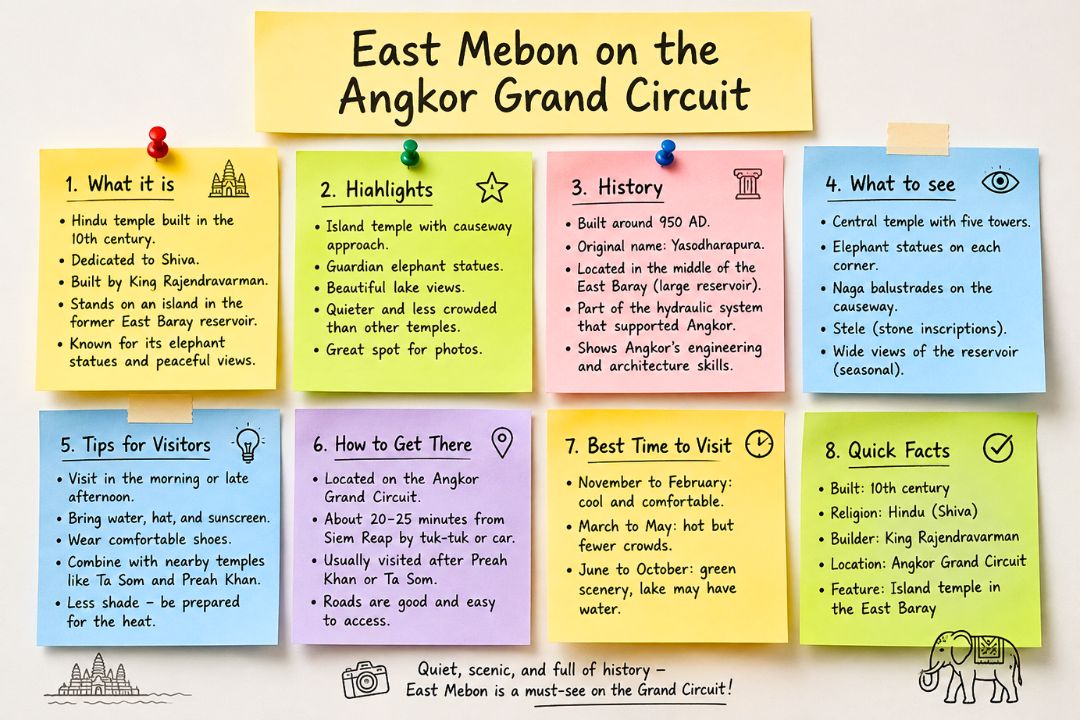
You also do not need a long lecture to get it. A few facts go a long way here. Built in 952. Hindu. Linked to Shiva. Placed on an island in the East Baray. Crowned by five towers that point to Mount Meru in Khmer temple thought.
And then there are the elephants. Not tiny carvings. Big, free-standing stone elephants at the corners. They give the temple muscle.
If you are planning one day on the Grand Circuit, this is the kind of stop that keeps the route from turning into a blur.
Why does East Mebon on the Angkor Grand Circuit matter?
It matters because East Mebon turns Angkor from a list of temples into a place you can actually read.
I say that with intent. Angkor is huge. UNESCO places the site at around 400 square kilometers, and the complex includes not only temples but also dykes, reservoirs, canals, and old routes. When you stop at East Mebon, you stop at a temple that still carries that larger water story in plain sight.
The temple stood on a small island in the middle of the East Baray, a massive reservoir fed by the Siem Reap River. Today the baray is dry and filled with rice land, so you have to picture the older scene in your head. Still, that effort pays off. Once you do, East Mebon stops being “another temple” and starts reading like a statement about royal power, religion, and water control.
I like using East Mebon as a bridge stop in the day. Angkor Wat shows scale. Bayon shows faces and mood. East Mebon shows structure and setting. That mix gives you a fuller read of Angkor.
| What you see | What it means | Why I point it out |
|---|---|---|
| Island setting inside the East Baray | The temple was tied to Angkor’s old water world | You start to grasp that Angkor was also an engineered city |
| Five towers on the upper level | A temple mountain image of Mount Meru | You can read Khmer sacred design without getting lost |
| Stone elephants on the corners | Power, guardianship, and visual drama | This is the detail many people remember first |
What do you actually see at East Mebon on the Angkor Grand Circuit?
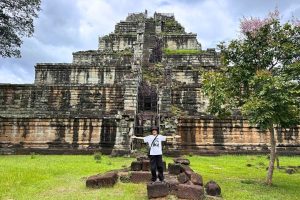
You see a 10th-century Hindu temple with five towers, steep levels, and stone elephants that still hold the place together.
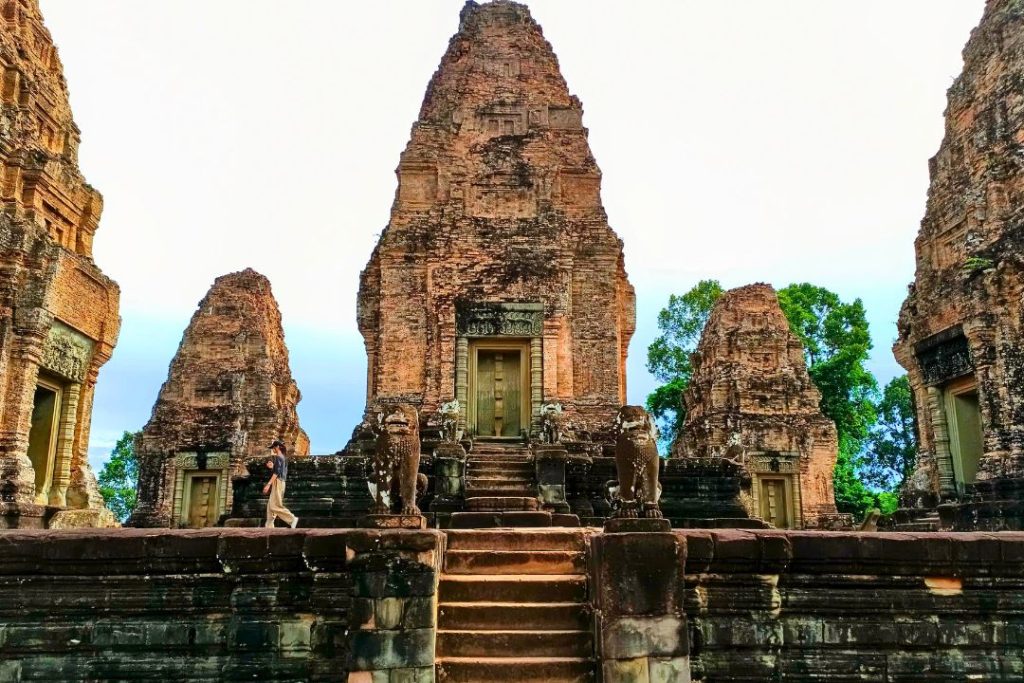
East Mebon was built in the second half of the 10th century, in 952, by King Rajendravarman II and dedicated to Shiva. It is often described as an ancestor temple tied to the king’s parents. The layout matters. You get a base with three tiers, three enclosures, and five towers set like the dots on a die.
I like that the form is readable from the ground up. You do not need to guess where your eye should go. The stairs pull you upward. Lions flank the stairways. The brick towers sit high. The whole thing feels ordered.
Then the elephants take over the mood. Tourism Cambodia notes the free-standing stone elephants on the corners of the first and second tiers, and that is the detail I tell you not to rush. Walk the corners. Look at the scale. Check the southwest elephant too, since it is often noted as one of the best preserved.
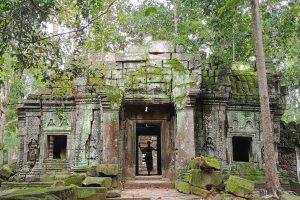
There is also more fine detail than many people expect. Entry towers. Brick sanctuaries. Lintels with Hindu figures. Laterite and sandstone used side by side. East Mebon is not a messy stop. It is a temple you can read piece by piece.
Is East Mebon on the Angkor Grand Circuit worth your time if you already saw Angkor Wat?
Yes. It gives you a different kind of temple read, and that is why I keep it in the route.
Angkor Wat is grand and iconic. East Mebon is tighter, sharper, and easier to grasp in one visit. That is not a lesser role. It is a useful one.
If you already saw Angkor Wat, East Mebon still gives you three things you may not have had yet:
- A direct link to Angkor’s water system
- A temple mountain layout you can read fast
- A quieter rhythm in the middle of the day
I also find that East Mebon works well for people who feel overloaded by major temple stops. You climb. You pause. You see the lines of the temple. You get the point. It sticks.
This is also why I like to place it with a route that includes other contrasting stops. Pre Rup gives you height and brick tones. Ta Som gives you a tighter temple feel and tree-framed scenes. Neak Pean shifts the mood again. Preah Khan closes the day with longer halls and more maze-like movement.
How do I fit East Mebon on the Angkor Grand Circuit into one day?
I fit it as a mid-route stop, often after Pre Rup and before Ta Som or Neak Pean.
That order works. Your eyes are still fresh. Your legs are still with you. The temple lands well before the late-day drag kicks in.
A clean day can look like this:
- Start early with ticket ready
- Reach Pre Rup first
- Move to East Mebon
- Continue to Ta Som
- Pause around Neak Pean
- Finish at Preah Khan
If you want a longer day with pink sandstone detail and a broader outer route, I would look at the Banteay Srei Backcountry Tour. That tour runs about 8 hours, starts hotel pickup around 7:40 am to 8:10 am, departs at 8:30 am, returns around 4:00 pm, costs $20, and keeps the group to 10 people. I like that shape for solo travelers and first-timers who want East Mebon in a route that still feels paced.
| Route choice | What the day feels like | Who I would send there |
|---|---|---|
| Grand Circuit core loop | Fast temple read with strong variety | First-time visitors with one Angkor day |
| East Mebon plus Banteay Srei route | Longer day with wider contrast | People who want East Mebon plus finer stone carving |
| Three-day Angkor pass plan | Less rush and more room to pause | Anyone who hates cramming too much into one day |
Which pass should you buy before East Mebon on the Angkor Grand Circuit?
For most first-time temple trips, I lean toward the 3-day pass, not the 1-day pass.
The official Angkor Enterprise rates are $37 for 1 day, $62 for 3 days, and $72 for 7 days. The official ticket list also shows access to 50+ temples, with Angkor Temples Park entry from 5:00 AM and closing at 6:30 PM.
If you are only doing one temple day, the 1-day pass may work. Still, I often point to the 3-day pass. It takes pressure off. You do not have to force Angkor Wat, Bayon, Ta Prohm, and the full Grand Circuit into one hard push. That kind of day can turn flat by noon.
A few rules matter:
- Children under 12 do not need a ticket, though age proof may be asked for
- Keep your pass with you inside the park
- Some outer sites need separate tickets
- Dress rules at temples still matter, so cover shoulders and knees
I also like that the ticket money is not the whole story. Siem Reap Shuttle notes that $2 from each pass goes to the Kantha Bopha children’s hospital fund. That is a small detail, but many travelers ask where the money goes.
What should you do next if East Mebon is on your list?
I would decide your pass first, then lock your route, then leave some room in the day.
That order saves stress.
If you want one direct move, start with the Banteay Srei Backcountry Tour. It already includes East Mebon with Pre Rup, Ta Som, Neak Pean, and Preah Khan. If you want a custom temple day, go to my contact tour planner form and send me your date, pass plan, and how much walking you want to do.
My own take is plain. East Mebon on the Angkor Grand Circuit is not a throw-in stop. It is one of the places that makes the loop make sense. You get stone elephants, tower geometry, royal history, and the lost water world of Angkor in one visit. If you want a temple day that feels thought through, not thrown together, give East Mebon real time.
More tours and Sources
- Banteay Srei Backcountry Tour with East Mebon and Preah Khan
- Angkor Grand Circuit tour with local guide for first-time visitors
- Preah Khan on the Angkor Grand Circuit
- Neak Pean on the Angkor Grand Circuit
- Angkor Temple Pass guide for first-time temple planning
- UNESCO Angkor World Heritage listing
- Official Angkor Enterprise ticket portal
- Official Angkor Enterprise available tickets
- Tourism Cambodia East Mebon temple guide
- Siem Reap Shuttle Banteay Srei Backcountry Tour
- Siem Reap Shuttle Angkor Temple Pass article
- Siem Reap Shuttle Angkor Pass explained article
- Siem Reap Shuttle post sitemap
- Siem Reap Shuttle sitemap index