Angkor Grand Circuit Architecture Explained – Best Real Plan Comparison Guide
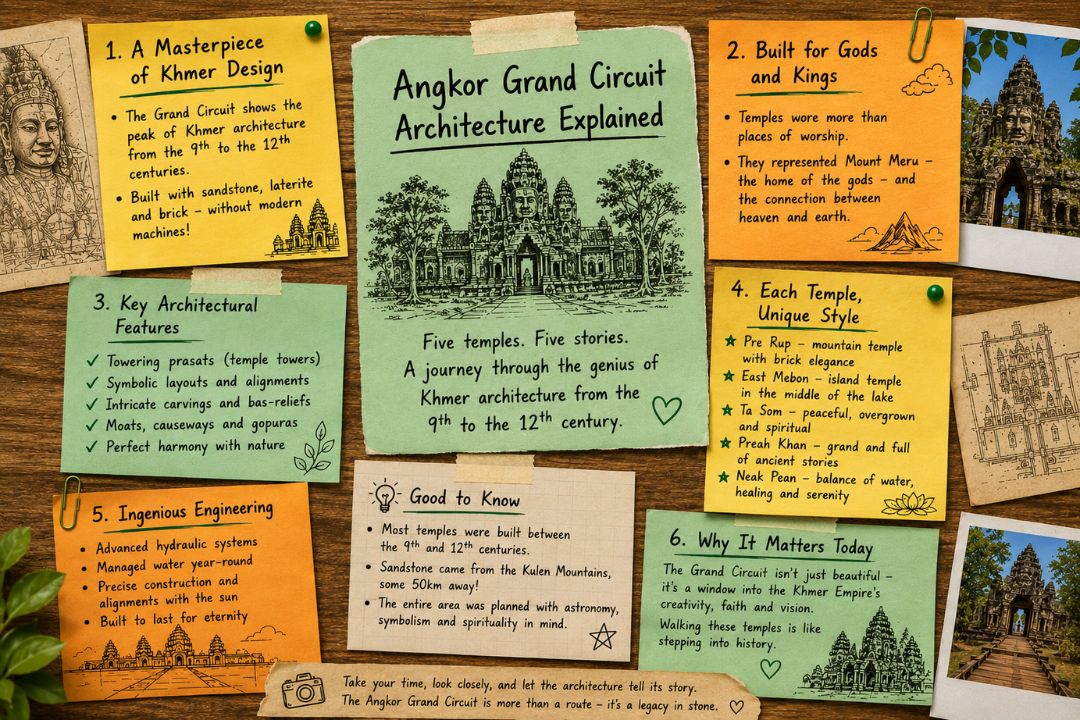
The Angkor Grand Circuit Architecture Explained in plain terms is this. You drive a 26 km loop around the northern and eastern edge of Angkor Thom, and the temples literally appear in chronological sequence. You start at a 10th century brick pyramid dated to 961 CE and finish at a 13th century Buddhist face tower carved under King Jayavarman VII around 1191 CE.
Six temples, one loop, eight centuries of Khmer stone building. Every traveler who rides this route with me leaves with a working mental timeline of Angkor.
What you need is one article that names every temple on the loop, gives the real year of construction, gives the real footprint in meters, and shows you why the bricks, the causeways, the pools, and the face towers look the way they do. That is what I deliver every week for our guests in Siem Reap.
What you actually see on the Angkor Grand Circuit
The Grand Circuit is a 26 to 28 km loop that extends the Small Circuit. Most itineraries stop at five main temples: Preah Khan, Neak Pean, Ta Som, East Mebon, and Pre Rup. Some drivers also include the small chapel of Banteay Prei or the bathing pool of Srah Srang. The full loop with a private driver takes four to five hours. Most groups start at 7:30 AM and finish before the mid-day heat sets in.
Quick facts before you go
- Pass prices set by the government and sold at the official Angkor Enterprise ticket office: 1-day $37, 3-day $62, 7-day $72.
- Loop length from Angkor Thom North Gate back to Angkor Thom North Gate: 26 to 28 km.
- Time on route with a private car and driver: four to five hours.
- Main temples on the loop: Preah Khan, Neak Pean, Ta Som, East Mebon, Pre Rup.
- Best start time: 7:30 AM, before the heat and before the tour buses leave Bayon.
How is the Grand Circuit different from the Small Circuit?
The Small Circuit stays inside Angkor Thom and Angkor Wat, about 17 km of stops. The Grand Circuit reaches further north and east to add Preah Khan, Neak Pean, Ta Som, East Mebon, and Pre Rup. You cover more ground, you see thinner crowds at most stops, and you get a clear view of how Khmer architecture changed between 961 CE and 1191 CE.
Why the loop matters for architecture fans
If you only visit Angkor Wat and Bayon, you miss the architectural bridge between Hindu temple mountains and Buddhist face tower sanctuaries. The Grand Circuit is exactly that bridge. Pre Rup and East Mebon show the 10th century brick pyramid style. Preah Khan, Ta Som, and Neak Pean show the later Bayon sandstone style with elaborate face towers. Travelers who skip this loop often leave Angkor thinking all Khmer temples look the same, which is the wrong read.
How do you read the Angkor Grand Circuit Architecture Explained as a stone timeline?
Khmer architecture on this route moves through three clearly visible Angkor periods. First you get early brick temple mountains that imitate Mount Meru rising from a cosmic sea. Then you get classical sandstone buildings with finer lintels. Then you reach the Bayon period under Jayavarman VII, where the entrance gates carry massive smiling faces of Avalokiteshvara and the compound layouts become more organic.
Three architectural eras at a glance
- 10th century Pre Rup style: brick and laterite, temple mountain pyramids, Hindu deities like Shiva and Vishnu.
- 11th to 12th century classical style: sandstone buildings, Vishnu and Shiva carvings, longer bas-reliefs.
- Late 12th to early 13th century Bayon style: sandstone face towers, Buddhist imagery, sprawling monastic compounds.
What does Preah Khan actually look like?
Preah Khan, sometimes spelled Prah Khan, is the largest temple on the Grand Circuit. King Jayavarman VII dedicated it in 1191 CE to his father, and the site covers about 138 acres of rectangular land inside a laterite wall and a moat. Long cruciform galleries, four enclosing walls, a central sanctuary, and naga-lined causeways crossing the moat give Preah Khan the feeling of a stone city rather than a single pyramid. Preah Khan also served as a temporary capital while Angkor Thom was still under construction.
You can read more about Preah Khan and why it feels so different from Angkor Wat in our guide to the Angkor Thom temple complex.
Preah Khan in two minutes
Plan 60 to 90 minutes here, because the galleries stretch for hundreds of meters. The east gopura is often covered in a strangler fig, similar to the famous tree roots at Ta Som and Ta Prohm but on a much bigger scale. Look up at the lintels where Buddhist and Hindu deities appear side by side. That mix is a clear sign of the religious blend under Jayavarman VII.
Why does Neak Pean sit on water?
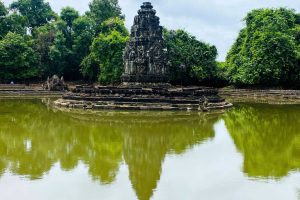
Neak Pean sits on a small circular island in the middle of the Jayatataka Baray, the northern reservoir built under Jayavarman VII. A single central shrine rises from the island. Four smaller basins surround it in a lotus shape, each connected to the central pool by a stone causeway with a naga balustrade. In the 12th century pilgrims treated these basins as places of ritual bathing and healing. The temple name means “coiled serpents,” taken from the intertwined naga statues at the corners of the basins.
Why Neak Pean is worth a 30 minute stop
The temple itself is tiny, close to the size of a small house. The drama is in the causeway walk out to the island and the four connected pools. Bring a wide lens if you photograph. A standard phone lens also works well because the central shrine rises cleanly out of the pond.
Why is Ta Som called a small Bayon temple?
Ta Som is a small late 12th century temple in pure Bayon style, built by Jayavarman VII near the eastern edge of the Jayatataka Baray. The layout is simple: one central sanctuary, one enclosing wall, four gopuras at the cardinal directions. The east gopura is the famous one. A strangler fig has grown over the face tower and now frames four smiling Avalokiteshvara faces under live roots. Many travelers describe Ta Som as a miniature Bayon, with the same Buddhist face towers in a quieter, more ruined setting.
Ta Som quick facts
- Date: late 12th century, Jayavarman VII.
- Style: Bayon period Buddhist.
- Time on site: 25 to 40 minutes.
- Photo tip: the west gopura at sunrise, the east gopura at any time because the tree stays shaded.
What makes East Mebon a reservoir temple?
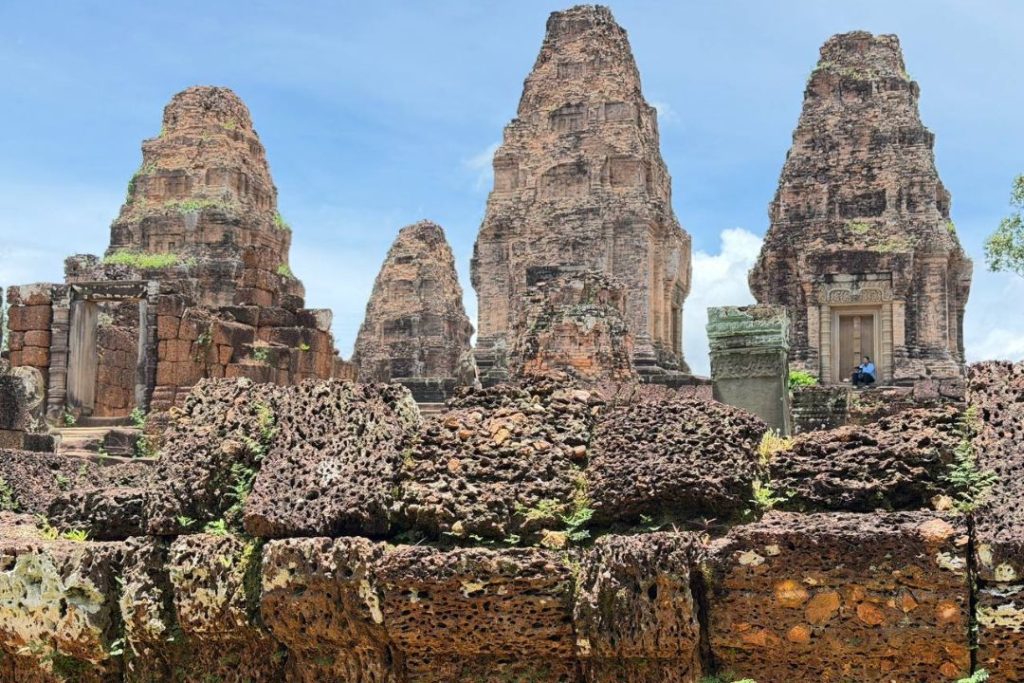
East Mebon was originally an island temple in the middle of the East Baray, a giant reservoir that is now dry farmland. King Rajendravarman II built it in the 10th century. The platform measures about 126 m by 120 m. The temple rises in three tiers with brick towers, sandstone lintels, and famous three-headed elephant guardians at the corners of the second terrace. The plan clearly anticipates Pre Rup, with five towers in a quincunx on the upper platform, four at the corners and one in the center.
East Mebon in 30 minutes
The east gate of East Mebon used to face the East Baray directly. Today the baray is dry, which makes the temple sit like a low hill rather than an island. You still climb three steep staircases that represent the climb up Mount Meru, and you still see the elephant guardians at the second level. East Mebon is the cleanest bridge stop between the Bayon Buddhist sites and the Hindu temple mountains.
What does Pre Rup mean for Khmer architecture?
Pre Rup is the textbook example of the 10th century temple mountain style. King Rajendravarman II built it in 961 CE. The outer laterite wall measures about 117 m north to south and 127 m east to west. The temple rises in three tiers with five towers in a quincunx on the upper platform, the five peaks of Mount Meru at the center of the Hindu cosmic mountain. Warm reddish brick with yellowish sandstone highlights is why Pre Rup glows so strongly in late afternoon light.
You can dig deeper into the pyramid details in our Pre Rup temple guide.
Why Pre Rup is the best sunset stop on the Grand Circuit
Most drivers end the Grand Circuit at Pre Rup, and there are two reasons. First, the western face of the pyramid catches the sun at golden hour. Second, the climb up the central staircase is short but steep, so you get a strong view over the surrounding forest. Plan 45 to 60 minutes here and bring water.
What role does the Angkor Thom North Gate play?
The Grand Circuit normally starts or ends at the Angkor Thom North Gate, the monumental sandstone entrance Jayavarman VII rebuilt around 1200 CE. The gate carries one large central face tower and two smaller face towers on the causeway, all carved with serene Avalokiteshvara or Lokesvara faces looking to the cardinal directions, plus devatas, apsaras, and Indra riding the three-headed elephant Airavata. The causeway itself runs on a long naga balustrade across the old moat. The North Gate sets the tone for the whole day because the face towers announce the Buddhist Bayon style before you even reach Preah Khan.
Tips for the North Gate
Go through the gate slowly on the way out and again on the way back. Most drivers stop once, but I recommend a short photo stop both times because the sun angles are different. Early morning, you get side light from the east. Late afternoon, you get side light from the west.
How the temples compare at a glance
This three column table gives you the year of construction, the real footprint, and the religious style for the five main Grand Circuit stops.
| Temple | Built | Approx. footprint | Style |
|---|---|---|---|
| Pre Rup | 961 CE | 117 m by 127 m outer wall | Hindu temple mountain, Pre Rup style |
| East Mebon | 10th century | 126 m by 120 m platform | Hindu temple mountain, brick |
| Preah Khan | 1191 CE | about 138 acres | Buddhist Bayon, monastic |
| Neak Pean | late 12th century | tiny island, one shrine | Buddhist Bayon, healing pools |
| Ta Som | late 12th century | small single compound | Buddhist Bayon, face tower gates |
Pass and price planning for the Grand Circuit
As of August 2026, the official Angkor Pass pricing set by the Cambodian government and sold through the Angkor Enterprise ticket office is $37 for one day, $62 for three days, and $72 for seven days. The three-day pass gives you the best value if you plan to do the Small Circuit, the Grand Circuit, and Banteay Srei over two or three days. The seven-day pass makes sense if you also want Beng Mealea, Koh Ker, or a relaxed sunrise round at Angkor Wat.
Our team put together a current pricing breakdown here: How Much Does It Cost to Enter Angkor Wat. For a full rundown of everything the pass covers, the Angkor Temple Pass guide is the page I send to guests before they arrive.
Pass options at a glance
| Pass | Price USD | Validity | Good for |
|---|---|---|---|
| 1-day | $37 | one calendar day | tight itinerary, Small or Grand only |
| 3-day | $62 | 10 days from purchase | Small and Grand plus one extra temple |
| 7-day | $72 | 30 days from purchase | full Angkor plus Beng Mealea or Koh Ker |
What is the best order to see the Grand Circuit?
Start at the Angkor Thom North Gate at 7:30 to 8:00 AM, drive north to Preah Khan for one hour, then Neak Pean for 30 minutes, then Ta Som for 30 minutes, then East Mebon for 30 minutes, then finish at Pre Rup for sunset. This is the order I run with my own clients because you move counterclockwise around Angkor Thom without backtracking, the religious eras appear in order, and you finish with the headline sunset view on the pyramid. If you also want the 967 CE pink sandstone temple of Banteay Srei, the Banteay Srei Backcountry Tour pairs cleanly with this loop as a half-day side trip.
Final plan
Here is what I want you to remember. The Angkor Grand Circuit Architecture Explained in one sentence is the story of a 10th century Hindu brick pyramid giving way to a 12th century Buddhist sandstone face tower, all on one quiet loop around Angkor Thom. The road is short, the temples are calm once you leave Angkor Wat behind, and every stop is a chapter in one unbroken story. So do the route once with a driver, walk slowly, and let the stone teach you the rest.
If you want to plan this loop with us, want to combine it with Banteay Srei on the same day, or want to add the Bayon jungle temples on a third day, our team is one click away on the contact page. We book private drivers, we walk you through the Angkor Pass process, and we keep the cold water coming between stops.
Sources
- Pass and cost deep dive: How Much Does It Cost to Enter Angkor Wat
- Angkor Thom gateway guide: Angkor Thom Temple Guide
- Banteay Srei pink sandstone side trip: Guide to Banteay Srei Temple
- The pyramid capstone stop from this article: Magnificent Pre Rup Temple
- Full pass coverage and validity rules: The Angkor Temple Pass: Everything You Need to Know
- Angkor Enterprise, official Angkor Pass and ticket office

![2 days in Siem Reap with Sunrise at Angkor a Khmer Apsara dinner show and Tonle Sap sunset tour [With one free airport transfer]](https://www.siemreapshuttle.com/wp-content/uploads/2026/06/2-days-in-Siem-Reap-with-Sunrise-at-Angkor-a-Khmer-Apsara-dinner-show-and-Tonle-Sap-sunset-tour-With-one-free-airport-transfer-300x300.jpg)