Why Visit the Angkor Grand Circuit? Discover Its History, Purpose, and Most Rewarding Temples
Why Visit the Angkor Grand Circuit? Five of Angkor’s biggest temples sit on this quieter 26 kilometer loop, and the right start time hands you Preah Khan almost alone.
Claim 12,000 square meters of Preah Khan carvings with only birds for company while Small Circuit traffic stacks at Ta Prohm.
Why Visit the Angkor Grand Circuit? Because it is the quiet half of Angkor, a 26 kilometer loop that most first time visitors skip. The Small Circuit collects the crowds at Angkor Wat, Bayon, and Ta Prohm. The Grand Circuit trades famous faces for space, shade, and ruined stone you can almost call your own.
The loop holds five temples with real weight. Preah Khan is the largest temple site after Angkor Wat itself. Neak Pean is an island shrine made for healing. Ta Som, East Mebon, and Pre Rup each bring something the west side lacks.
So here is the short test. Why Visit the Angkor Grand Circuit? If you want more room, bigger ruins, and a slower pace, the answer is yes. This guide gives you each stop, the story behind it, and how long to stay at every one, plus the route trick that pairs the loop with Banteay Srei.
What this guide gives you
Why Visit the Angkor Grand Circuit? In one read you get the temple lineup, the ticket math, and the crowd timing most visitors learn the hard way. I cover the five main stops in route order, with visit times and photo spots, plus the tour I book when I want a guide.
Key takeaways
- The loop runs about 26 kilometers and links five major temples under one Angkor pass.
- Preah Khan alone can fill 90 minutes, and it is the biggest temple site after Angkor Wat.
- Tickets run 37 dollars for one day, 62 dollars for three days, and 72 dollars for seven days.
- The park opens at 5 am and closes at 6:30 pm, so an early start turns the loop into a full day.
- The route lines up well with Banteay Srei and the backcountry on the same ticket.
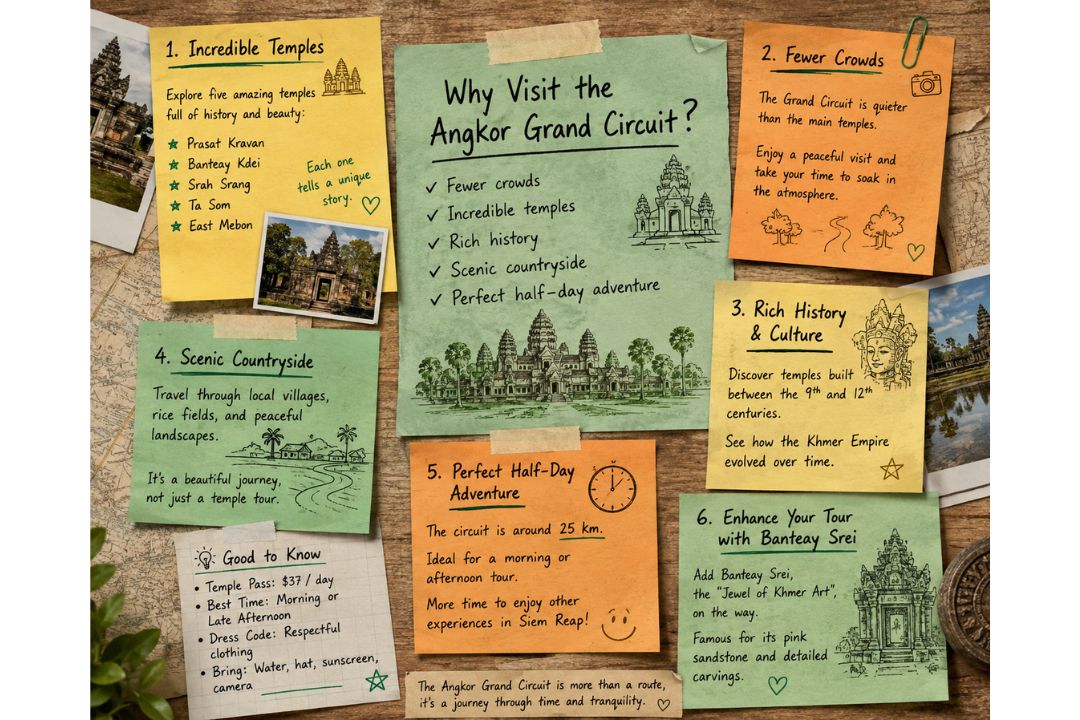
Why Visit the Angkor Grand Circuit? What Sets This Route Apart?
The short answer: quieter, wider, bigger.
The Grand Circuit’s five temples sit along 26 kilometers of tree lined road, and most tour groups spend their mornings on the Small Circuit instead, so you meet far fewer people at each stop.
I have run this loop more times than I can count. You roll out of town before the buses, pass through the North Gate of Angkor Thom, and suddenly the road empties. The Small Circuit runs about 17 kilometers and grabs the famous names: Angkor Wat, Bayon, Ta Prohm. The park drew 955,131 foreign visitors in 2025, and the biggest crowds cluster on that western loop. The Grand Circuit stretches further, to about 26 kilometers, and that extra distance makes the difference. Fewer vans. More birds. Temples where the only sound is your own boots on stone.
The two circuits became the standard ways to see the park decades ago, with the Grand Circuit heading east through the older ceremonial zone around the East Baray. What worked for early visitors still works for you: one road, five temples, one day.
What Is the History and Purpose of the Grand Circuit?
The one sentence version: five temples, two centuries, one road.
The loop links temples raised more than two hundred years apart, from East Mebon in 953 to Preah Khan in the late 1100s, and its job for you is plain. One road. Five different temples, each with its own job. Done before dinner.
The east side of Angkor is the older ceremonial ground. King Rajendravarman II raised East Mebon on an island inside the East Baray reservoir in 953, then finished Pre Rup, the brick temple mountain, around 961 or early 962. Two hundred years later, King Jayavarman VII raised temples across the whole empire. Preah Khan, Neak Pean, and Ta Som all date to his reign in the late 12th century.
Jayavarman VII had a plan for his temples. They doubled as monasteries, rest houses, and healing centers. Neak Pean carried the nickname Hospital Temple because pilgrims bathed in its pools and believed the water cured them. Preah Khan spread over 2.2 square kilometers as a monastery, a university, and a place of worship all at once. You are not walking five identical monuments. You are walking five answers to one question: how do you raise a sacred city that actually works?
The Five Temples of the Grand Circuit, in Route Order
Preah Khan, the giant that still surprises me
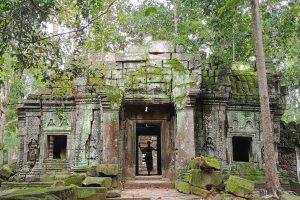
Give it 90 minutes, and start here. Preah Khan is the largest temple site in the park after Angkor Wat, yet it gets a fraction of the visitors. A 100 meter causeway lined with giants holding a naga snake crosses the moat, then four enclosures, long galleries, and collapsed towers spread across the site. Roughly 12,000 square meters of carved stone fill those halls. My standard advice to first timers: pace yourself, because the finest carvings sit in the far rooms where the tour groups never go.
Neak Pean, the island made to heal
Give it 30 quiet minutes. Neak Pean sits on a 350 by 350 meter island in the middle of a man made lake. Five pools radiate from a central shrine on a lotus shaped base, joined by waterspouts carved as a lion, a horse, an elephant, and a human face. Pilgrims came here to bathe and be healed. Walk the boardwalk, watch the water, and keep moving. The mood is the whole point.
Ta Som, where a tree owns the gate
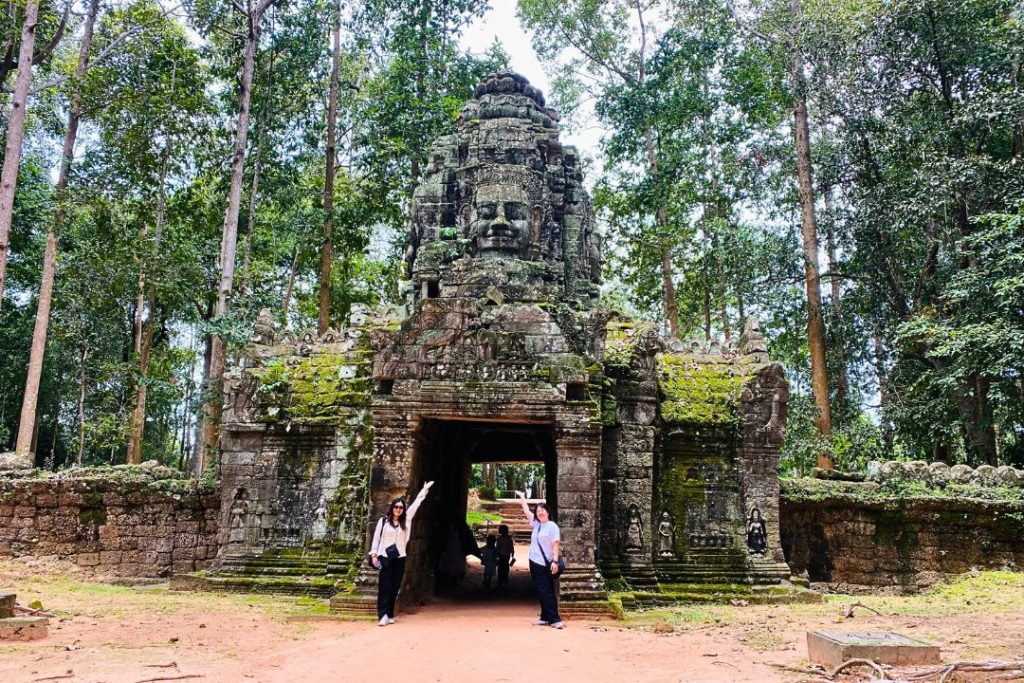
Give it 45 minutes. Ta Som dates to the late 12th century and the reign of Jayavarman VII. Most people come for one thing: the eastern gate, where a giant strangler fig grows on top of the sandstone and its roots drip over the portal. Stand in front of it and you get a Ta Prohm moment with a fraction of the people.
East Mebon, the temple on a dried lake
Give it 40 minutes. East Mebon was dedicated in 953 by King Rajendravarman II, standing on an island inside the East Baray. The water is gone. The temple stays. Two enclosing walls and three tiers climb to a platform where five towers stand. The shot everyone waits for is the pair of two meter high elephants carved at each corner, standing guard over a lake that dried out long ago.
Pre Rup, the pyramid that catches the sunset
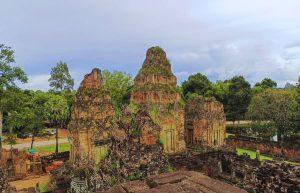
Give it 40 minutes, and save it for last. Pre Rup is a temple mountain with three levels and five towers, finished around 961 or early 962 under Rajendravarman II. The climb is short and the payoff is tall. From the top you look east toward Phnom Bok and the Kulen mountains, and west over the forest toward the towers of Angkor Wat. I use Pre Rup as the sunset stop on this loop on purpose.
| Temple | Built | Why it matters |
|---|---|---|
| Preah Khan | Late 1100s, Jayavarman VII | Largest site after Angkor Wat; 90 minutes of galleries and jungle |
| Neak Pean | Late 1100s, Jayavarman VII | Island healing shrine with five pools |
| Ta Som | Late 1100s, Jayavarman VII | Strangler fig owns the eastern gate |
| East Mebon | 953, Rajendravarman II | Island temple with two meter elephant statues |
| Pre Rup | 961 to 962, Rajendravarman II | Brick pyramid with a wide sunset view |
Grand Circuit vs Small Circuit: Which Should You Pick?
The short answer: one day means Small, two days means both.
Pick the Small Circuit if you have exactly one day and want the icons. Pick the Grand Circuit for day two, or for the whole day if you have already seen Angkor Wat and Ta Prohm and want space.
The Small Circuit is the classic lineup: Angkor Wat at sunrise, Bayon’s stone faces, Ta Prohm with its roots, all packed into 17 kilometers. It is brilliant, and it is busy. The Grand Circuit swaps fame for breathing room across 26 kilometers, and its temples are the ones that surprise repeat visitors.
| Small Circuit | Grand Circuit | |
|---|---|---|
| Road distance | About 17 km | About 26 km |
| Headline temples | Angkor Wat, Bayon, Ta Prohm | Preah Khan, Neak Pean, Pre Rup |
| Crowd level | Heavy from sunrise | Lighter all day |
| Best for | One day in the park | A second day, or a quiet first day |
| Pace | Four to five quick stops | Five slower stops, early start |
If you can spare two days, I would not choose at all. Run the Small Circuit on day one, then take the Grand Circuit on day two and add Banteay Srei if your legs agree. My three day plan in Siem Reap lays this out stop by stop, so you never repeat a temple.
Why Visit the Angkor Grand Circuit? What Does It Cost and When Do You Start?
The short answer: 37 dollars for one day, and the loop fits between a 5 am start and a 6:30 pm close.
Prices are current as of August 2026. The Angkor pass costs 37 dollars for one day, 62 dollars for three days, and 72 dollars for seven days. Gates open at 5 am and close at 6:30 pm, and the loop needs a morning plus an afternoon.
The ticket math is kinder than it looks. A one day pass is fixed to a single date. The three day pass spreads across seven calendar days, and the seven day pass across thirty, which is why the Grand Circuit almost always lands on day two of a longer visit. Every pass clears 50 temples in the park, so this loop costs you nothing extra.
Start early, and I mean early. The park opens at 5 am. Enter with the sunrise crowd and you can stand inside Preah Khan before the tour vans roll in, then spend midday at East Mebon and Pre Rup. Cover your shoulders and knees. The authorities enforce the dress rules at every gate.
Should You Add Banteay Srei and the Backcountry to the Same Day?
The short answer: yes, on the eight hour backcountry loop.
The Banteay Srei Backcountry Tour stacks Pre Rup, Banteay Srei, East Mebon, Ta Som, Neak Pean, and Preah Khan into a single day, with a local guide and cold water on board.
I run this route myself, and it fixes the one weakness of the Grand Circuit. On your own, you never reach Banteay Srei, the pink sandstone masterpiece about 30 kilometers northeast of town. The tour folds it in. You leave your hotel at 8:30 am, ride in an air conditioned minivan with cold water and towels, and a local guide walks you through six temples before dropping you back around 4 pm. Groups cap at ten people, small enough to move at your own speed. The shared tour runs 20 dollars.
One Angkor pass, six temples, and you are back in town for dinner.
“Banteay Srei is the jewel of Khmer art, a masterpiece that must be seen to be believed.” I agree with that line from our own trip diary. Its pink sandstone carvings, including the 200 devatas that cover the walls, belong on every Siem Reap itinerary. If you want the Grand Circuit plus the backcountry in one day flat, book the Banteay Srei Backcountry Tour and let someone else take the wheel.
Your Next Steps, in Order
- Buy your Angkor pass online before you arrive, through the official Angkor Enterprise site, so the ticket booth queue costs you nothing.
- Start the loop at Preah Khan no later than 8 am, then work east through Neak Pean, Ta Som, East Mebon, and Pre Rup.
- Read the Angkor temple pass guide so the pass windows make sense.
- Pack sleeves, long pants or skirt, water, and a hat. The temple etiquette rules spell out the details.
- Pick the shared tour or a private day, then send your plan through the contact page, and I will confirm the details within 24 hours.
My Last Word on the Grand Circuit
I have lost count of the travelers who told me the Grand Circuit was their favorite day in Cambodia. Mine too. Why Visit the Angkor Grand Circuit? Because five temples, 26 kilometers, and one early start give you the version of Angkor that postcards miss. So do this: buy your pass online, pick a bright morning, and book the Banteay Srei Backcountry Tour if you want the loop plus the pink temple in one sweep. Then reach out through the contact page, and we will put the whole plan together.
The Small Circuit shows you Angkor. The Grand Circuit lets you hear it. That difference is worth the early alarm.