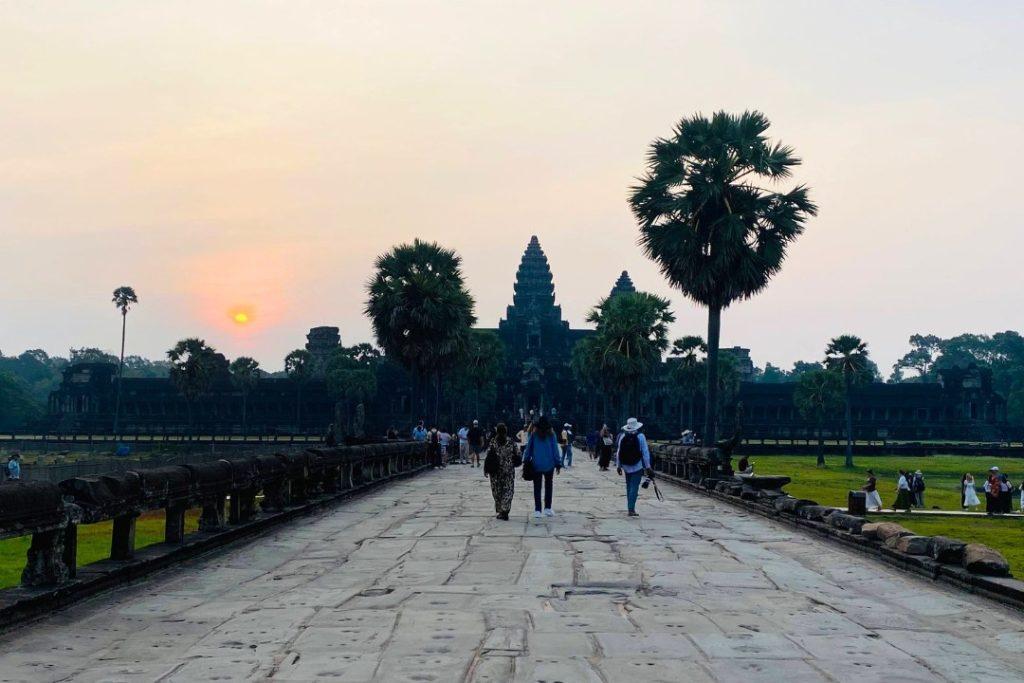
How much does a 5-day trip to Siem Reap cost? Build a total trip budget
Know your full 5-day Siem Reap budget before you book so you can spend smarter on temples, meals, transport, and tours from day one.
How much does a 5-day trip to Siem Reap cost? If I were planning it today, I’d tell you to budget about $305 for a lean trip, $465 for a comfortable trip, and $785+ for a more private, upgrade-heavy trip — and that’s before international flights.
For most travelers, the sweet spot is a 3-day temple plan with a mix of one or two shared tours, simple local meals, and a smart airport transfer. The biggest fixed cost is the official temple ticket, while the easiest place to save money is transport and hotel style. And honestly? With the right plan, Siem Reap is one of those rare destinations where your budget can stay sensible while the experience still feels huge.
Quick feature-rich summary: How much does a 5-day trip to Siem Reap cost? Usually less than many travelers expect — especially if you book a few small-group tours, use a shared airport transfer, choose the right Angkor Pass, and avoid wasting money on random same-day transport decisions.
Key benefits: easy planning, lower transport stress, better time use inside the temple zone, and a smoother mix of culture, nature, and downtime.
Key takeaways
- I’d budget $305 for a basic but very doable 5-day trip in Siem Reap
- I’d budget $465 for the most balanced comfort-to-value trip
- I’d budget $785+ if you want more privacy, more convenience, and premium transport
- For 5 days, the 3-day Angkor Pass is usually the smartest choice
- Shared tours can be better value than piecing together separate tuk tuk rides
- The dry season Cambodia months are easiest for weather, but the rainy season Cambodia months can save you money
- Booking direct with Siem Reap Shuttle can simplify the whole trip — airport, temples, lake, waterfall, and evening culture
How much does a 5-day trip to Siem Reap cost?
Short answer: for 5 days in Siem Reap, I’d plan on $305, $465, or $785+, depending on how you travel.
That’s the practical answer to How much does a 5-day trip to Siem Reap cost? for most independent travelers in 2026. I’m talking about your on-the-ground trip budget — accommodation, temple access, local transport, tours, meals, and a bit of buffer — not your international flight.
If you want the fastest version: budget travelers can keep costs low without missing the headline experiences, comfortable travelers can have a very smooth trip without going overboard, and upgrade-focused travelers can add more private service without crossing into luxury-resort territory.
| Travel style | What it usually includes | 5-day total |
|---|---|---|
| Lean budget | Guesthouse, shared airport transfer, simple meals, 3-day temple pass, small-group tours | $305 |
| Comfortable | Boutique stay, better food mix, 3-day pass, shared tours + one evening experience | $465 |
| Private-leaning | Better hotel, round-trip private transport, more flexibility, private day transport | $785+ |
What does that total usually exclude?
It usually excludes international flights, travel insurance, visa costs if they apply to you, shopping, bar-heavy nights, and personal splurges. So yes — if you love silk scarves, rooftop cocktails, and extra massages, your number will climb. Fast.
What do you actually need to pay for in Siem Reap?
The real cost comes down to six things: arrival, hotel, temple access, tours, food, and local transport.
If you’re wondering again, How much does a 5-day trip to Siem Reap cost?, this is where the math happens. The trip is affordable because a lot of your costs are optional — but the ones that matter most are pretty easy to predict.
Here’s the cleanest way I’d break it down.
| Cost item | Lean budget | Comfortable budget |
|---|---|---|
| Airport transfers | $18 | $60 |
| Hotel for 4 nights | $96 | $220 |
| Temple pass | $62 | $62 |
| Tours & activities | $75 | $110 |
| Food & drinks | $44 | $88 |
| Tips, snacks, buffer | $10 | $25 |
My practical reading of that table
The hotel and the style of transport change your budget more than almost anything else. The temple ticket is fixed. Meals are flexible. Random transport choices? That’s where travelers quietly leak cash.
And that’s why I usually recommend starting with your airport plan first. If you want the cheapest clean arrival from the new airport, book the shared SAI Siem Reap airport transfer. If you like predictability, that’s an easy first win.
Which Angkor Pass makes the most sense for 5 days?
For a 5-day trip, the 3-day Angkor Pass is usually the best value.
This is the part a lot of people overthink. For How much does a 5-day trip to Siem Reap cost?, the pass you choose matters because it affects your entire pace. The official prices are $37 for 1 day, $62 for 3 days, and $72 for 7 days. For most 5-day visitors, the 3-day pass hits the sweet spot.
Why? Because Angkor Archaeological Park is huge. You’re not just looking at Angkor Wat. You’re moving through Angkor Thom, Bayon, Ta Prohm, Banteay Srei, Preah Khan, Neak Pean, Ta Som, East Mebon, Pre Rup, Phnom Bakheng, and maybe quieter stops like Banteay Kdei if you build in time. Trying to crush all of that into one pass day sounds efficient. It usually isn’t.
What I’d do instead
- Use one temple day for an Angkor Wat sunrise
- Use one day for the outer circuit and smaller temples
- Use one day for a fuller classic route with sunset
That gives you room to actually enjoy the place — and that matters here. You’re walking through the legacy of the Khmer Empire, where Hinduism and Buddhism shaped the art, symbolism, and temple design on a staggering scale. It’s also a UNESCO World Heritage zone, so this isn’t the kind of destination I’d rush just to save ten dollars.
If you’re buying tickets, use the official Angkor Enterprise site for current details.
What 5-day plan gives you the best value?
The best-value 5-day trip mixes 3 temple-focused days with 1 cultural or nature day and 1 light arrival/departure day.
This is where How much does a 5-day trip to Siem Reap cost? becomes more useful than just a number. Because the best budget is not the absolute cheapest one — it’s the one that gives you the best return on your time.
Day 1: Arrive smart, not stressed
I’d start with the shared airport transfer from SAI unless you’re arriving with family or a lot of luggage. It’s simple, predictable, and stops you from paying panic-pricing after landing.
Also, before you fly, check the official Cambodia arrival portal at arrival.gov.kh. Don’t leave arrival formalities to the last minute.
Day 2: Do the classic Angkor Wat sunrise morning
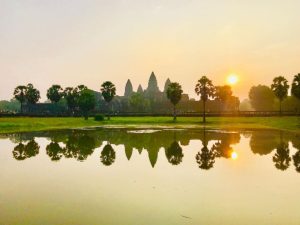
If you want the postcard moment, book the Angkor Sunrise Tour. This is the most efficient way to see Angkor Wat, Bayon, and Ta Prohm before the day gets brutally hot.
And yes, I think a small guided temple tour is worth it here. A good guide turns carved stone into a real story instead of a long, sweaty photo walk.
Day 3: Go deeper than the famous trio
I really like the Banteay Srei Backcountry Tour for day three. It gives you Pre Rup, Banteay Srei, East Mebon, Ta Som, Neak Pean, and Preah Khan in one strong day.
This is also where your trip starts to feel less generic. You’re no longer only chasing the “must-sees.” You’re actually understanding the landscape.
Day 4: Choose water or mountain
You’ve got two smart value options here.
If you want local life beyond the temples, book the Kompong Phluk Floating Villages Tour. It takes you to Kompong Phluk Floating Village on Tonle Sap, and it’s a good contrast to three days of stone, jungle roots, and bas-reliefs.
If you want nature and sacred mountain scenery, go with the Kulen Waterfall Tour. That gets you into Phnom Kulen National Park, where the mood shifts completely — forest, river carvings, waterfall, mountain air. Different energy. Very worth it.
Day 5: Pick your final style — classic or adventurous
If you still want the core icons done properly, the Explore Angkor tour is a strong closer. You’ll cover Angkor Thom, Bayon, Ta Prohm, Angkor Wat, and Phnom Bakheng — ideal if you want an Angkor Wat sunset finish.
If you’d rather go farther out, choose the Koh Ker and Beng Mealea tour. Beng Mealea is wonderfully wild, and Koh Ker feels different from the central park temples. It’s less polished, more atmospheric, more remote.
Is it cheaper to book tours or do everything yourself?
Usually, small-group tours win on value unless you’re very confident with timing and logistics.
A lot of travelers assume DIY is automatically cheaper. Sometimes it is. Sometimes it really isn’t. In Siem Reap, the cost gap between doing it yourself and booking the right tour can be surprisingly small.
| Option | Best for | Budget reality |
|---|---|---|
| tuk tuk DIY day | Flexible travelers doing one short temple day | Cheap at first, but adds up over several days |
| bicycle day | Very budget travelers, short route only | Cheapest, but only practical for limited temple coverage |
| Shared tour / private car | Time-saving, small-group, multi-stop days | Often best overall value when pickup and guide are included |
Here’s my honest take: for one simple day, a tuk tuk is fine. For long multi-stop temple routes, a shared tour often works better. And if you’re in a family or small group, a private car can become reasonable very quickly on a per-person basis.
That’s another reason the answer to How much does a 5-day trip to Siem Reap cost? depends less on “cheap vs expensive” and more on “organized vs improvised.”
When is the cheapest time to visit Siem Reap?
The cheapest months are usually in the rainy season Cambodia, while the easiest weather is in the dry season Cambodia.
If your budget matters more than perfect weather, low season is worth serious thought. The dry season Cambodia period is easier for early starts, cleaner roads, and clearer temple walks — but it also brings higher room rates and bigger crowds.
The rainy season Cambodia months can be a very smart budget play. Hotels usually soften their pricing, there are fewer tourists around, and the landscape gets greener. Yes, you may deal with sudden rain. But honestly? Some travelers prefer the moodier, greener version of Angkor.
My simple seasonal advice
- Want easier weather and classic sunrise conditions? Go in the dry season.
- Want lower prices and fewer people in your photos? Consider the rainy season.
- Want the best balance? Shoulder-season timing is often ideal.
And yes, this question changes How much does a 5-day trip to Siem Reap cost? more than people think, especially once hotel rates start moving.
What optional experiences are actually worth adding?
Add one cultural evening and one non-temple day if you want the trip to feel complete.
Temples are the headline. I get it. But five straight days of temples can flatten the experience a bit. One evening show or one lake/mountain day can make the trip feel more rounded.
I’d seriously consider the Robam Theatre Grand Buffet Dinner and Apsara Show. At $25, it’s one of the cleaner, easier evening add-ons because dinner, hotel pickup, and the performance are bundled. It’s also a nice way to connect what you saw in the temples with living Khmer performance culture.
And if you’re still asking How much does a 5-day trip to Siem Reap cost?, this is the kind of add-on that improves the trip without wrecking the budget.
So, what budget would I personally recommend?
I’d recommend planning around $465 for most first-time travelers.
That number gives you breathing room. Not luxury. Not backpacker hardship. Just a good, realistic trip.
Here’s what I like about that middle budget:
- You can stay somewhere comfortable
- You can use a proper arrival setup
- You can get the 3-day Angkor Pass
- You can do a couple of well-chosen tours
- You can eat well without obsessing over every dollar
- You can still say yes to one memorable extra
And for most people, that’s the real answer to How much does a 5-day trip to Siem Reap cost? — not the rock-bottom number, but the number that lets the trip feel easy.
Conclusion: my honest take on how much a 5-day trip to Siem Reap cost?
If you asked me over coffee, How much does a 5-day trip to Siem Reap cost?, I’d say this: it’s one of the best-value trips in Southeast Asia if you plan the core pieces first. Lock in your airport transfer, choose the right Angkor Pass, decide whether you want shared tours or more independence, and leave a little room for one experience that isn’t “just another temple.” That’s the difference between a cheap trip and a smart trip.
My advice is simple. Start with your dates. Decide whether you want lean, comfortable, or private-leaning travel. Then book your essentials in this order: airport transfer, hotel, temple plan, and one or two add-on experiences. If you want help putting the pieces together, contact the team here: plan your Siem Reap trip with local help.