What to See in Kompong Phluk Floating Village? Experience Cambodia’s Most Authentic Water Community Without the Tourist Circus
Discover the stilt houses, flooded forests, and real village life that makes Kompong Phluk worth every minute of the journey from Siem Reap
What to see in Kompong Phluk floating village? You’ll witness 10-meter-tall stilt houses that rise and fall with Tonle Sap Lake’s dramatic water levels, navigate through sunken mangrove forests by small boat, watch local fishermen casting nets using techniques passed down for generations, explore a Buddhist pagoda serving the water community, and observe schools, markets, and homes where 3,000 people thrive on Asia’s largest freshwater lake.
How to get to Kompong Phluk from Siem Reap? The village sits just 30 kilometers from Siem Reap—a 45-minute drive followed by a main boat ride through water channels. Tours run twice daily with hotel pickup, taking 5 hours total and costing $24-28 per person with transparent pricing available online. This authentic floating village near Siem Reap delivers experiences you won’t find at heavily-touristed alternatives, combining natural wonders with genuine cultural immersion that transforms how you understand Cambodian resilience.
–
What to See in Kompong Phluk Floating Village? 11 Must-See Sights Near Siem Reap Cambodia
So you’re wondering what to see in Kompong Phluk floating village?
Smart question. Because not all floating villages deliver the same experience. Some feel like theme parks. Others feel invasive. Kompong Phluk hits differently.
Here’s what makes this village remarkable: it’s still a working fishing community. People aren’t performing for tourists. They’re living their actual lives on stilts above water that rises and falls 7 to 9 meters every single year.
Let me walk you through the 11 sights that make this half-day journey worth blocking out time in your Siem Reap itinerary.
1. The Stilted Houses That Defy Logic and Gravity
First thing you notice? The houses.
These aren’t cute little raised platforms. These are full-sized family homes perched on wooden poles stretching 6 to 10 meters above ground. During dry season (April through July), you see the entire structure exposed. The poles look impossibly thin for supporting entire families, furniture, and cooking supplies.
When you visit during high water season (August through March), those same houses sit just 1 to 2 meters above the water line. The lake swallows 8 meters of pole height.
Families adapt twice yearly to this dramatic shift. They store belongings in waterproof containers. They anchor boats differently. They adjust fishing nets based on water depth.
What to see in Kompong Phluk floating village that shows human ingenuity? Start here. These homes represent centuries of adaptation to one of Southeast Asia’s most dynamic lake systems.
You’ll pass schools, shops, and temples all built the same way. Kids climb ladders to get to class. Grandmothers descend steps to board boats for market runs.
The architecture tells you everything about resilience before your guide says a word.
2. The Flooded Forest That Feels Like Another Planet
This is the moment that defines your trip.
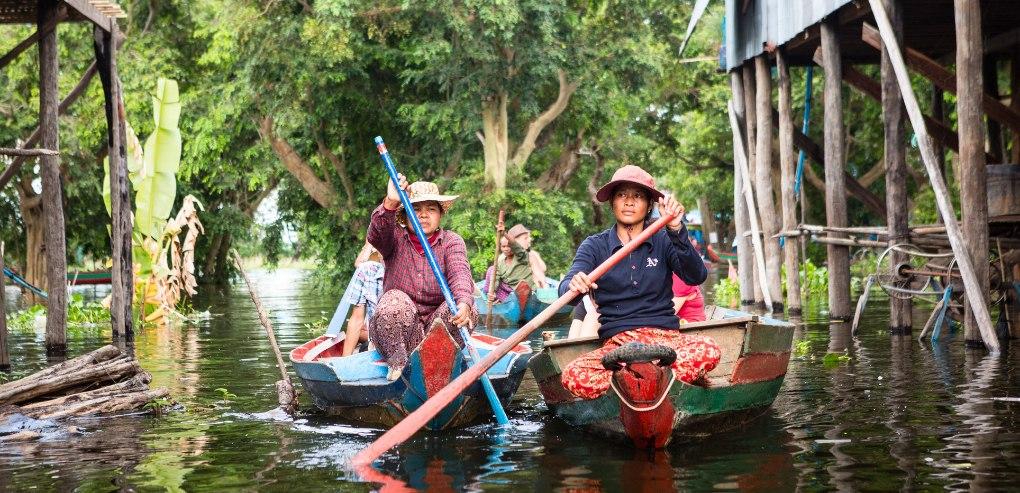
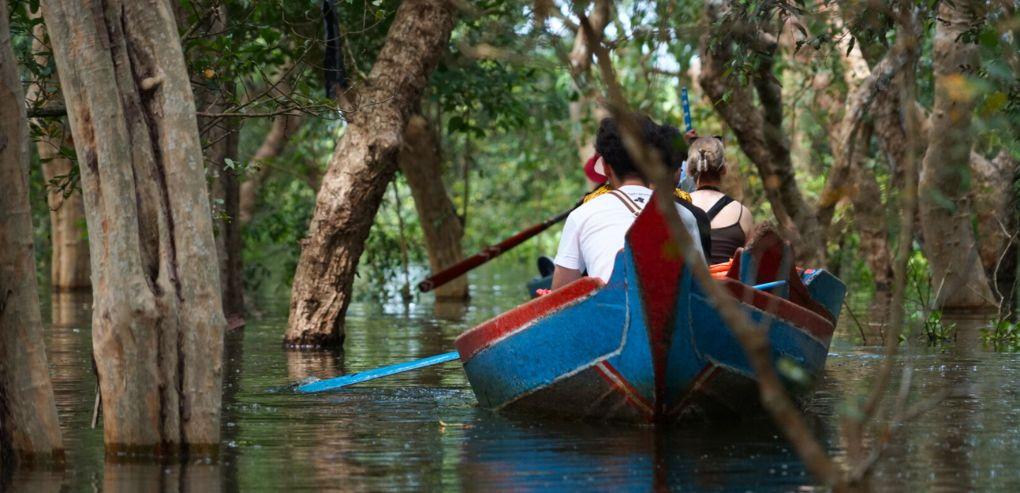
You transfer from the main boat into a small wooden canoe. A local woman rows (yes, women do this work and keep 100% of the fees plus tips). She navigates channels so narrow that branches brush your shoulders.
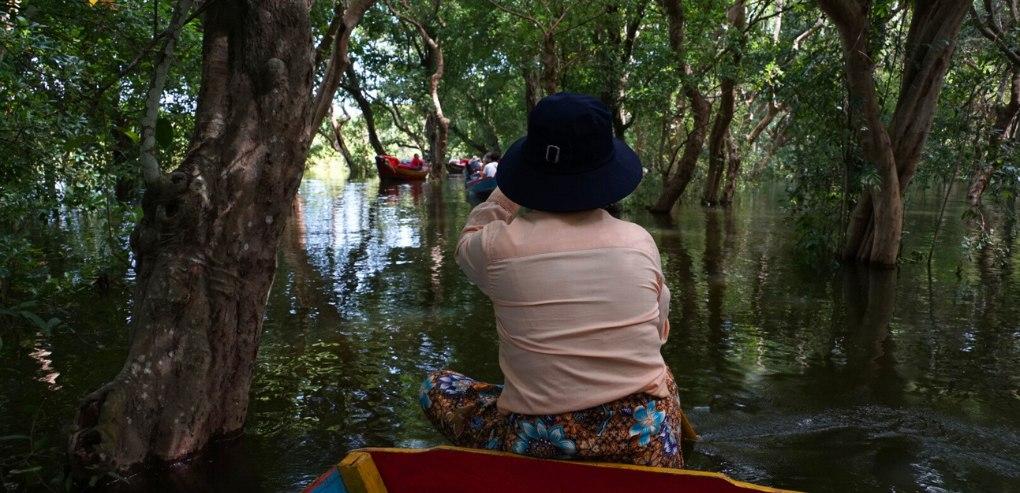
The flooded forest exists because Tonle Sap Lake expands massively during monsoon season. What’s normally dry land becomes a 3-meter-deep aquatic forest. Mangrove trees grow from underwater roots. Their trunks rise from water instead of soil.
Sunlight filters through the canopy. Everything glows green. The silence breaks only from bird calls and water lapping against the boat.
You might spot monkeys swinging between branches. Water monitors swimming past. Kingfishers diving for fish.
This optional add-on costs $5 per person and takes 30 to 45 minutes. Skip it and you miss what to see in Kompong Phluk floating village that everyone remembers most vividly.
The rowers are incredibly strong. Watch their arms as they pull the oars. They do this route multiple times daily, year-round. It’s humbling.
Some visitors ask to try rowing. You’ll last maybe 2 minutes before realizing this takes serious skill.
3. The Fish Farms That Feed Millions
Tonle Sap Lake provides protein for 3 million Cambodians. Kompong Phluk contributes significantly to that supply chain.
You’ll see floating fish farms—large netted enclosures attached to pontoons. Families raise catfish, snakehead fish, and tilapia. They feed them, monitor growth, and sell to wholesalers who transport catches to Phnom Penh and beyond.
During your boat ride, guides explain the fishing cycles. When the lake floods during monsoon season, fish breed in enormous numbers. As water recedes in dry season, fish concentrate in remaining pools and channels. That’s when families harvest intensively.
Some families also farm shrimp. The water quality of Tonle Sap—fed by the Mekong River system—creates ideal conditions for freshwater shrimp that fetch premium prices.
What to see in Kompong Phluk floating village that connects to Cambodia’s economy? These working fish farms. Tourism provides supplemental income, but fishing remains the primary livelihood for most residents.
You’re not just observing a quaint activity. You’re witnessing food security in action.
4. The Buddhist Pagoda Serving the Water Community
Every floating village has a spiritual center. In Kompong Phluk, the Buddhist pagoda sits elevated above the water on reinforced stilts.
Your tour typically includes a brief stop here. Remove shoes before entering. Dress respectfully (covered shoulders and knees).
The pagoda serves multiple functions. Monks live here year-round. Families bring offerings. Children learn Buddhist teachings. During festivals, the entire village gathers for ceremonies.
The interior features traditional Khmer Buddhist artwork—golden Buddhas, lotus motifs, and murals depicting moral lessons. Incense smoke drifts through the space. The atmosphere feels peaceful despite being surrounded by a bustling village.
If you visit on holy days (check lunar calendar dates with your guide), you might witness ceremonies with chanting, drums, and families in ceremonial white clothing.
This stop reminds you that what to see in Kompong Phluk floating village isn’t just physical structures. It’s a complete community with spiritual traditions maintaining cultural identity despite challenging living conditions.
5. The Local Market Where Real Life Happens
Before heading to the main boat dock, tours often stop at the local market serving villages around Tonle Sap Lake.
This isn’t a tourist market. Nobody’s selling keychains or t-shirts.
You see dried fish hanging from rafters. Live eels in buckets. Vegetables grown on floating gardens. Rice sold by the sack. Household goods—soap, shampoo, cooking oil—stacked on wooden shelves.
Women negotiate prices. Men load purchases into boats. Kids chase each other between stalls.
The market operates on a barter-and-cash hybrid economy. Some families trade fish for vegetables. Others pay in riel (Cambodian currency) or dollars.
Smells hit you hard: fish, spices, mud, and tropical humidity create a distinctive aroma. It’s not unpleasant, just unfamiliar.
What to see in Kompong Phluk floating village that shows authentic daily life? Spend 15 minutes observing this market. Watch how transactions happen. Notice the social interactions. You’ll understand more about the village economy than any guidebook explains.
6. The Floating Schools Educating the Next Generation
Education happens on water here.
The floating school sits on a large platform secured by multiple stilts. Classrooms have basic desks, chalkboards, and posters. Teachers live in Kompong Phluk or commute from nearby villages.
Kids arrive by boat, obviously. They tie up at the school’s dock and climb stairs. School uniforms are standard—white shirts, blue skirts or pants.
Tours typically pass by schools without entering (to avoid disrupting classes). But you’ll see kids during breaks playing on platforms, splashing in the water, and doing what kids everywhere do: laughing, teasing, and burning off energy.
The Cambodian government supports these schools, but resources remain limited. Some organizations donate supplies—textbooks, pencils, backpacks.
What to see in Kompong Phluk floating village that gives you hope? These schools. Despite poverty and environmental challenges, families prioritize education. They believe the next generation will have opportunities beyond fishing.
That commitment to learning, in such challenging circumstances, hits differently than reading about education statistics.
7. The Traditional Fishing Techniques Passed Down for Generations
Throughout your boat ride, you’ll witness active fishing.
Men cast circular nets from small boats. The technique looks simple but requires perfect timing and wrist action. The net opens mid-air, lands flat on water, and sinks with weighted edges trapping fish underneath. The fisherman then pulls a center rope, closing the net like a drawstring bag.
Other families use fish traps—woven bamboo cages with funnel entrances. Fish swim in but can’t find the exit. Families check traps daily, harvesting catches and resetting for the next cycle.
Some larger operations use seine nets—long curtains of netting that hang vertically in the water. Teams of fishermen slowly encircle fish schools, then pull the net closed from both ends.
These methods aren’t romanticized traditions maintained for tourists. These are the actual working techniques families depend on for survival and income.
How to get to Kompong Phluk from Siem Reap to witness these fishing methods? Book a tour with morning or afternoon departures. Morning tours (8:30 AM start) catch more active fishing. Afternoon tours (2:30 PM start) see net-mending and processing.
Your guide explains which fish are valuable, which seasons produce best harvests, and how market prices fluctuate based on supply.
8. The Handicraft Workshops Supporting Women’s Cooperatives
Scattered throughout Kompong Phluk, small workshops produce traditional Cambodian handicrafts.
Women weave baskets from water reeds. Others create silk scarves using hand looms. Some workshops produce silver jewelry or stone carvings.
These aren’t aggressive sales operations. Most workshops welcome curious visitors but don’t pressure purchases. If you want to support local artisans, this is where your money goes directly to families.
Prices are reasonable: baskets cost $3-8, scarves $10-20, silver jewelry $15-40 depending on complexity.
What to see in Kompong Phluk floating village that supports community development? These cooperatives. Tourism created demand for handicrafts beyond fishing income. Women control earnings and often invest in children’s education or home improvements.
The craftsmanship is legitimate. These aren’t factory products imported from China. Watch weavers working their looms. The patterns follow traditional Khmer designs passed through family lines.
If you purchase something, you’re taking home an actual piece of Cambodian culture while supporting family income.
9. The Floating Restaurants Serving Lake-Fresh Fish
Midway through tours, you’ll pass floating restaurants anchored in scenic spots.
These aren’t included in standard tour prices (meals are extra). But if you’re hungry or curious, they offer the freshest fish you’ll eat in Cambodia.
The fish literally came from the lake that morning. Sometimes from the restaurant owner’s own nets. Preparation is simple: grilled with salt, pepper, and lime. Served with rice and morning glory vegetables.
Prices run $5-12 per meal depending on fish size. The ambiance beats any Siem Reap restaurant: you’re eating on a platform surrounded by water, watching boats pass, feeling the gentle rock of the pontoons.
Some restaurants also serve Cambodian specialties: amok (coconut curry steamed in banana leaves), lok lak (stir-fried beef), or num banh chok (Khmer noodles with fish gravy).
What to see in Kompong Phluk floating village that connects food to place? These restaurants. The meal literally couldn’t be more local—fish from beneath your feet, prepared by families living on the water.
Budget travelers can skip this and eat later in Siem Reap. Food enthusiasts should absolutely stop.
10. The Water-Based Transportation System
In Kompong Phluk, boats replace cars, trucks, and motorcycles.
You’ll see every type of watercraft: tiny fishing canoes paddled by single operators, mid-sized family boats with outboard motors, larger cargo boats hauling supplies from mainland markets, and tourist boats like yours ferrying visitors.
The “roads” are water channels maintained by community cooperation. Families dredge passages during dry season to ensure boats can still navigate. They mark shallow areas with poles during low water.
Some families own multiple boats—fishing boats, school-run boats, and cargo boats. Boat maintenance happens constantly. You’ll see men repairing hulls, replacing motors, and caulking leaks.
How to get to Kompong Phluk from Siem Reap and experience this transportation system? Your tour includes the main boat ride as part of the package. The boat captain navigates channels with practiced ease, avoiding fishing nets, other boats, and shallow patches.
This water-based infrastructure shows remarkable adaptation. Families accomplish everything urban dwellers do—shopping, school runs, work commutes, social visits—entirely by boat.
11. The Sunset That Makes Afternoon Tours Worth Scheduling
If you book the afternoon tour (2:30 PM departure, 7:30 PM return), you end with sunset on Tonle Sap Lake.
The sky explodes into orange, pink, and purple. Fishermen become silhouettes against the color. The water reflects everything, doubling the visual impact.
Your boat idles in a scenic spot. Everyone pulls out phones and cameras. The guides give you 15 to 20 minutes to soak it in.
This sunset doesn’t just look beautiful. It represents the end of the workday for fishing families. Boats return to villages. Kids finish homework by lantern light. Families prepare dinner.
What to see in Kompong Phluk floating village that captures the village’s rhythm? This sunset transition from work to rest. You’re witnessing the close of a day in a community that operates entirely differently from your normal life.
Morning tours miss this but get back to Siem Reap by 1:30 PM, leaving your afternoon free. Afternoon tours sacrifice that flexibility for this unforgettable light show.
Combining Kompong Phluk With Other Siem Reap Adventures
The 5-hour tour duration makes combination days possible:
Option 1: Morning Angkor Wat sunrise (4:30 AM start) + Afternoon Kompong Phluk tour (2:30 PM start)
Option 2: Morning Kompong Phluk tour (8:30 AM start) + Afternoon temple exploration or hotel relaxation
Option 3: Kompong Phluk afternoon tour with sunset (2:30 PM start) + Evening Phare Circus performance
Browse other Siem Reap experiences through Siem Reap Shuttle’s tour collection to build your ideal itinerary.
Turning Information Into Experience
You now know what to see in Kompong Phluk floating village. You understand how to get to Kompong Phluk from Siem Reap. You’ve got pricing, timing, and ethical considerations covered.
The next step is simple: Book the tour. Block out 5 hours. Choose morning if you want cooler weather and afternoon flexibility. Choose afternoon if you want that incredible Tonle Sap sunset.
Pack sunscreen, a hat, insect repellent, and cash for the optional boat rides and tips. Bring curiosity and respect.
The village will still be there in a year or five years. But your Cambodia trip is happening now. The memories stick around longer than any temple photo.
Over the next decade, climate change and development will transform Tonle Sap Lake. The fishing industry faces pressure from upstream dams and environmental shifts. Communities like Kompong Phluk adapt, but uncertainty clouds the future.
Visiting now means witnessing a way of life that has sustained families for generations—before those generations decide whether water-based living remains viable.
You’re not just a tourist taking photos. You’re a witness to remarkable human resilience.
Need help planning your entire Siem Reap itinerary around this experience? Contact Siem Reap Shuttle for personalized recommendations that balance temples, nature, culture, and ethical tourism practices.
The lake is waiting. Those stilt houses aren’t going anywhere this week. But your Cambodia trip has limited days.
Make those 5 hours count.
Helpful Resources for Planning Your Kompong Phluk Experience
Before you book and pack, verify details through trusted sources:
Official Temple Information: Angkor Enterprise – If you’re combining Kompong Phluk with Angkor Wat temples, this official site provides current pass prices and regulations.
Kompong Phluk Tour Booking: Floating Villages Tour – Direct booking with transparent pricing, small groups, free airport transfer included.
Tour Duration Details: How Long Does a Floating Village Tour Take? – Complete timing breakdown for planning your day.
Ethical Tourism Guide: Kompong Phluk Ethical Tour Cambodia – Understanding which tours benefit communities versus corporations.
These resources connect you with verified operators, accurate information, and booking platforms supporting local families instead of distant investors.